Church of Saints Peter and Paul in Krakow: Foucault pendulum
A church built for the Jesuits with Zygmunt III Waza as founder, consecrated in 1635, with Father Piotr Skarga buried in its crypt.
9 min walk from the Main Market SquareDirections
The Church of Saints Peter and Paul in Krakow stands on Grodzka Street behind a row of apostle statues, about 50 m in a straight line from St Andrew's Church. Its full Polish name is Kościół Świętych Apostołów Piotra i Pawła, and it is a parish church of the Roman Catholic Parish of All Saints. The National Institute of Cultural Heritage lists visiting hours; the parish holds Masses and, on Thursdays, shows a Foucault pendulum.
- Address: Grodzka 52a, 31-044 Krakow, as given by the parish.
- Mass times: on Sundays and holidays at 8:00, 9:30, 11:00, 12:30 and 18:00 (as listed in October 2026).
- Opening hours: Tuesday to Saturday and on Sundays and holidays, with different hours from April to October and from November to March, according to the National Institute of Cultural Heritage (as listed in October 2026).
- Accessibility: a tactile model with Braille descriptions stands on Grodzka Street.
Visiting the Church of Saints Peter and Paul and Mass times
On Sundays and holidays, Mass is said at 8:00 and 9:30, then at 11:00 and 12:30, and in the evening at 18:00 (as listed in October 2026). According to the National Institute of Cultural Heritage, the church is open to visitors from Tuesday to Saturday from 9.00 to 17.00 in the months from April to October. From November to March the hours on those days are 11.00 to 15.00. On Sundays and holidays the church is open to visitors from 13.30 to 17.30.
These visiting hours come from the National Institute of Cultural Heritage (as listed in October 2026), so confirm them with the parish. The Institute also says that various concerts are often held in the church. The crypt, where Father Piotr Skarga is buried, is open to visitors.
A tactile model of the churches of Saints Peter and Paul and St Andrew stands on Grodzka Street, at the foot of the first apostle statue from the left. Its Braille descriptions are in Polish and English.
The Foucault pendulum on Thursdays
Every Thursday the parish shows a Foucault pendulum in the church, at 10.00, 11.00 and 12.00 (as listed in October 2026). The National Institute of Cultural Heritage calls it the largest pendulum in Poland. The parish advises calling its office the day before your visit to make sure the show will take place.
The parish office phone number is +48 12 4226573. Times can change; check the current details on the website of the parish of Saints Peter and Paul before your visit.
The twelve apostles on Grodzka Street
The square in front of the church is a former cemetery, separated from Grodzka Street by twelve apostle statues on tall stone plinths joined by a metal balustrade. In 1722 the Jesuit sculptor Dawid Heel made the original fence, designed by Kacper Bażanka. It was dismantled in 1959 because of its poor condition, and Kazimierz Jęczmyk carved the 20th-century copies that replaced the statues. The figure of St Peter was funded by John Paul II soon after he became Pope.
What to see in the Church of Saints Peter and Paul
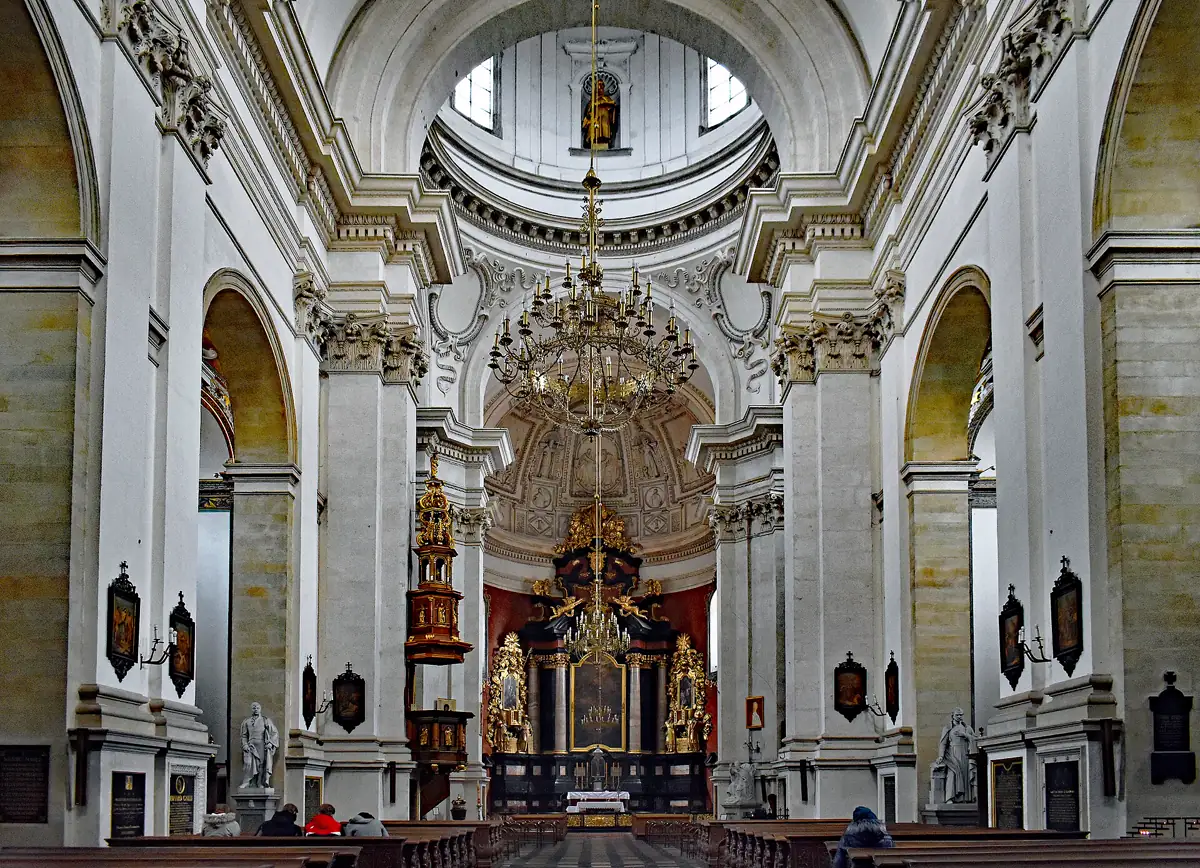
The two-storey façade of dolomite recalls the church of Santa Susanna in Rome, and it also echoes the façade of Il Gesù, the main Jesuit church in Rome. According to the city authorities, this façade became a model for other churches in Poland. A cartouche with Snopek, the coat of arms of the Vasa dynasty, crowns its upper storey. Figures of St Sigismund and St Ladislaus, patron saints of the Polish kings of the Vasa dynasty, who were benefactors of the church, stand in niches on both sides of the nave window.
Dawid Heel also made the four Jesuit saints on the lower part of the façade and probably the four wooden statues at the base of the dome. The National Institute of Cultural Heritage writes that the first design planned a dome in the shape of a half-sphere. Trevano made it slimmer and gave it a half-elliptical section, typical of the Baroque.
The rectangular plan contains a Latin cross with a short chancel (the area around the high altar) that ends in a semicircular apse. Three pairs of identical chapels, linked by passages, open onto the nave through arches.
The interior is monumental but plain, according to the city authorities, and has a late Baroque high altar. The National Institute of Cultural Heritage writes that Kacper Bażanka designed the high altar in 1725. The vault shows the stories of Saints Peter and Paul, and the decoration of the church is meant to symbolise the Western and Eastern Churches. By a pillar of the dome stands a bronze font from 1528, brought here from the demolished Church of All Saints.
Father Piotr Skarga, a writer, preacher and confessor of King Zygmunt III Waza (Sigismund III Vasa), is buried in the crypt. According to the city authorities, he rests under the central part of the chancel.
History of the Church of Saints Peter and Paul
After they came to Krakow, the Jesuits settled at the church of St Stephen in 1579 and later received the church of St Barbara, but the small church lent to them made large-scale pastoral work difficult. In 1595 the Jesuits secured King Zygmunt III Waza as their founder, and preparatory work began. The Jesuit architect Józef Britius drew the first sketches of the buildings: a house for the professed members of the order and a church.
The king gave money for the building thanks to the intercession of Father Piotr Skarga, according to the city authorities. Work began in 1597 with the laying of the foundation stone, and in 1605 the church was almost ready. A first attempt to vault the dome in 1610 failed, and the dome was finished in 1619.
Decoration and finishing work continued until the consecration in 1635. The National Institute of Cultural Heritage calls the church the first Baroque building in Krakow. The city authorities place it among the most outstanding achievements of Polish architecture of the 17th century.
In 1719 a fire in the college building also damaged the church: the roof timbers and part of the furnishings burned. The suppression of the Jesuit order by Pope Clement XIV in 1773 started half a century of gradual decay. According to the city authorities, the church then served for a time as a garrison church and even as an Orthodox church.
The situation improved in 1824, when the parish moved here from the demolished collegiate Church of All Saints. In 2010 the church became the third national pantheon, after Wawel Cathedral and the Skałka Sanctuary, according to the city authorities. The feast of Saints Peter and Paul, the church's patrons, falls on 29 June.
Near the church: Kanonicza Street and the Dominican Basilica
The Pod Temidą milk bar is about 100 m in a straight line from the Church of Saints Peter and Paul. Kanonicza Street is about 150 m away, and the Dominican Basilica is about 250 m away. The Collegium Broscianum building, where students of the Jagiellonian University study, stands next to the church.
Church of Saints Peter and Paul: questions visitors ask
When is the Foucault pendulum shown in the Church of Saints Peter and Paul?
On Thursdays: the first show is at 10.00 and the last at 12.00, as listed in October 2026. The parish suggests a phone call to its office the day before.
Who is buried in the Church of Saints Peter and Paul?
Father Piotr Skarga, court preacher of King Zygmunt III Waza, in the crypt under the chancel.
Where is the Church of Saints Peter and Paul in Krakow?
On Grodzka Street, next to St Andrew's Church and the Collegium Broscianum. The parish gives the address as Grodzka 52a.
Photo: Zygmunt Put, Wikimedia Commons, CC BY-SA 4.0, cropped.
Other places worth seeing
Ready to explore?
Book a tour, hop on an electric cart, or arrange a transfer.