Auschwitz-Birkenau Tour from Krakow
At a glance
What makes this tour different
No queues, no guesswork. Everything is arranged so the day is about understanding, not logistics.
Your day, step by step
A typical morning departure. Exact times are confirmed with your booking; the full round trip runs about 6 to 7 hours.
-
08:00
Private pickup from your Kraków hotel.
-
09:30
Arrival at the Memorial, security check and entry.
-
10:00
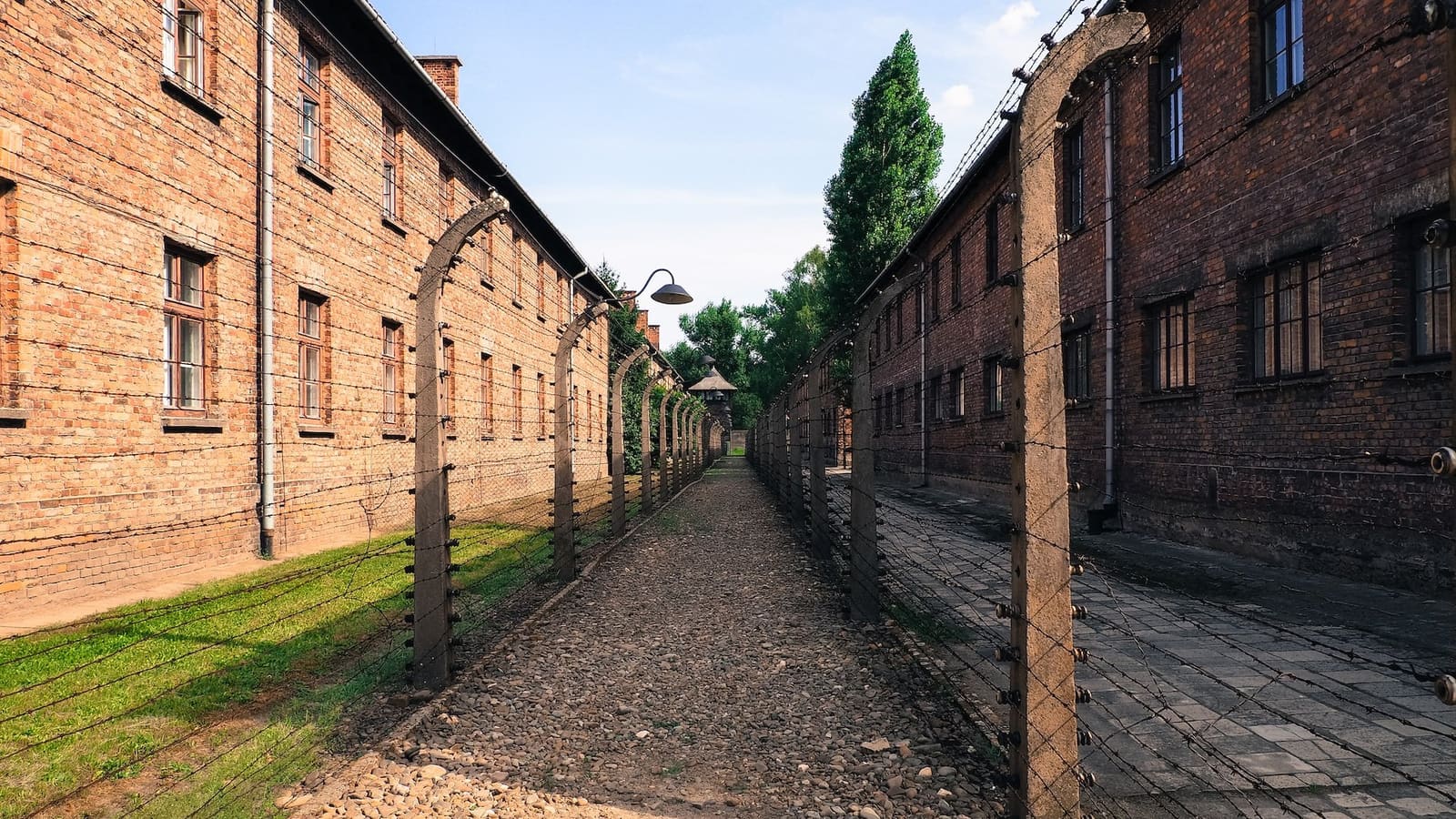
Guided tour of Auschwitz I: the brick blocks, the museum exhibitions and the "Arbeit Macht Frei" gate.
-
12:00
Short break at the visitor centre.
-
12:30
Transfer by the free Memorial shuttle to Birkenau, 3.5 km away.
-
13:00
Guided tour of Auschwitz II-Birkenau: the barracks, the railway ramp and Gate of Death, and the ruins of the gas chambers.
-
15:00
Return drive to your Kraków hotel.
Auschwitz I and Birkenau: the difference
You visit both. Many people do not realise they are two distinct sites, 3.5 km apart.
Auschwitz I
The original 1940 camp and administrative centre. It holds the surviving brick blocks and the main museum exhibitions.
Auschwitz II-Birkenau
Far larger, and the principal site of extermination. Here you walk among the barracks and the railway ramp.
Before you go
A few practical things the Memorial asks of every visitor.
Carry your passport or ID. It can be checked at the Memorial.
Only bags up to 30 x 20 x 10 cm are allowed inside. Larger bags go into paid lockers (about 5 PLN). Travel light.
Around 3 km of walking on uneven, historic ground, mostly outdoors.
Most of Birkenau is open and exposed. Dress for the day: sun, wind, rain or cold.
An airport-style check (X-ray and metal detectors) at entry, so allow a little time.
Allowed in most areas for private use, but forbidden in the hair exhibition (Block 4) and the basement of Block 11.
A cafe and toilets are at the visitor centre; eating is not allowed on the memorial grounds.
The Memorial recommends visitors be aged 14 and over.
Good to know
- This is a memorial and place of mourning, not a tourist attraction. The visit is calm and respectful.
- There are no dramatic reconstructions and no "jump scares", the site speaks for itself.
- Your guide sets a measured pace and gives context, not shock.
- Photography has restrictions in a few sensitive areas, which your guide will explain.
- It is a moving experience. Most visitors find it profound and important rather than distressing.
Who is this tour for?
A great fit if you
- Are visiting for the first time and want real context
- Are interested in WWII and Holocaust history
- Are an adult, or a family with teenagers (14+)
- Prefer a small, unhurried group with a licensed guide
Perhaps reconsider if you
- Are travelling with children under 14 (the Memorial's guidance)
- Have limited mobility or cannot walk ~3 km on uneven ground
- Are looking for light, casual sightseeing
Meet your guide
Your visit is led by a licensed, MPTI-certified educator accredited by the Auschwitz-Birkenau Memorial, specialised in WWII and Holocaust history. Their role is not only to show you the site but to help you understand it: the individual stories, the historical context and the meaning of what happened here.
Plan the rest of your trip
Ready to visit Auschwitz-Birkenau?
Reserve your date with a licensed guide. Free cancellation up to 24 hours before, and no payment until after the tour.
Full details & FAQ
About this tour
Auschwitz-Birkenau Memorial and Museum is one of the most important historical sites in the world - the largest Nazi German concentration and extermination camp, where over 1.1 million people were murdered between 1940 and 1945. A visit here is a profound act of remembrance and an essential part of understanding 20th-century history.
Our licensed guide leads you through both Auschwitz I - the original camp with its infamous "Arbeit Macht Frei" gate, prisoner barracks, and exhibition blocks - and the vast grounds of Auschwitz II-Birkenau, with its reconstructed watchtowers, rail tracks, and ruins of the gas chambers and crematoria. The guide provides deeply researched historical context while ensuring the tour remains respectful and emotionally supportive.
We depart early from Kraków to arrive before the main crowds, maximising the time and atmosphere for reflection. Entry tickets are included. This tour is not about shock - it is about understanding, honouring the victims, and carrying their memory forward.
Highlights
- Auschwitz I - original camp, prisoner barracks, exhibition halls
- The "Arbeit Macht Frei" gate and Appellplatz (roll call square)
- Auschwitz II-Birkenau - the massive extermination camp grounds
- Ruins of gas chambers and crematoria at Birkenau
- Licensed, MPTI-certified memorial guide with deep historical expertise
What's included
- Entry tickets to Auschwitz-Birkenau Memorial
- Licensed guide (MPTI certified)
- Private transport from Kraków
- Hotel pickup & drop-off
- Headsets for guided tour
Not included
- Meals (café on-site, budget ~30-50 PLN)
- Gratuities for guide
- Personal travel insurance
- Audio guide upgrade
Hotel pickup
We pick you up from your hotel or apartment anywhere in Kraków. Exact time after booking.
Cancellation policy
Free cancellation up to 24 hours before the tour
What to Bring
- Comfortable walking shoes
- Light jacket or layers
- Sunscreen and sunglasses
- Small backpack with water
- Valid ID / passport
- Cash (PLN) for meals and tips
Accessibility
Our tours can be adapted for most accessibility needs. Contact us in advance and we will arrange appropriate transport and routing.
Frequently asked questions
Is photography allowed at Auschwitz?
Photography is permitted in most areas but must be done with respect. There are specific areas - such as inside gas chambers - where photography is not allowed. Your guide will explain the rules.
How emotionally difficult is this tour?
This is a deeply moving experience. Most visitors find it profound and important rather than traumatising. Our guides are trained to provide emotional support and historical context throughout.
Are children allowed?
The memorial recommends visitors be at least 14 years old. We follow this guidance. The content is graphic and sobering - parental discretion is advised for younger teens.
Why should I use a guided tour rather than visiting independently?
Licensed guides bring the history to life in a way that self-guided visits cannot match. Their knowledge of individual stories, historical context, and the layout ensures you understand - not just see - what happened here.