St Catherine's Church in Krakow: St Rita roses and cloisters
The Gothic church of the Augustinian monastery complex in Kazimierz, with a Jordan family tomb from the workshop of Santi Gucci and a free-standing belfry.
22 min walk from the Main Market SquareDirections
St Catherine's Church in Krakow (kościół św. św. Katarzyny Aleksandryjskiej i Małgorzaty) stands on Augustiańska Street in Kazimierz, about 200 m in a straight line from Plac Wolnica and the Ethnographic Museum. The Church of St Catherine of Alexandria is the seat of a Roman Catholic parish and of the monastery of St Catherine of Alexandria, and it is part of the Augustinian monastery complex. On the 22nd of each month, its Masses include the blessing of roses.
Visiting St Catherine's Church and the St Rita Masses
The church is a monastery church and today is also a parish church. The National Institute of Cultural Heritage notes that the Augustinian monastery complex is accessible from the outside.
On the 22nd of each month, Masses with the blessing of roses are at 7:00 and 8:00, then at 10:00 and 12:00, and in the evening at 18:00 (as listed in October 2026). When the 22nd falls on a Sunday, they are at 7:00 and 9:00, then at 11:00 and 12:15, and at 18:00.
The Rosarium św. Rity, a small shop in the historic belfry on the corner of Augustiańska Street and Skałeczna Street, sells religious items connected with the veneration of St Rita of Cascia, and also fresh roses. From May to October it is open from Monday to Friday, 10:00 to 16:00, and all year round it also opens on the 22nd of each month (as listed in October 2026). The current schedule is listed on the website of the parish of St Catherine of Alexandria.
What to see in St Catherine's Church
The church is one of the largest Gothic buildings in Krakow and one of the finest monuments of Małopolska, according to the National Institute of Cultural Heritage. It is built of stone and brick as a basilica of four bays, with a nave taller than the aisles beside it. The combination of a long chancel (the part of the church around the high altar) with a short nave is typical of Gothic architecture in Krakow.
From outside, the tall, slender chancel is closed on five sides and has buttresses decorated with stone pinnacles. Between the buttresses are pointed windows with stone tracery and stained glass. The stone south aisle with its porch stands out against the brick architecture, with rich detail on its outer walls, pinnacles and portals. The Parler workshop built it in the final stage of construction, through the efforts of the lords of Brzezie, whose Zadora coats of arms decorate the keystones of its vault.
Inside, the richly decorated Baroque high altar of 1631-1636 dominates. On the south side of the nave stands the Mannerist tomb monument of the Jordan family from the early 17th century, made in the workshop of Santi Gucci. The National Institute of Cultural Heritage says that this mausoleum of a magnate family is widely regarded as a masterpiece of Polish Mannerism. A series of 17th-century paintings with scenes from the life and legend of St Augustine hangs on the north wall of the nave.
The vault of the main nave is a false vault made of wood. It was built during the restoration of 1852-1864 to recreate the destroyed original vault.
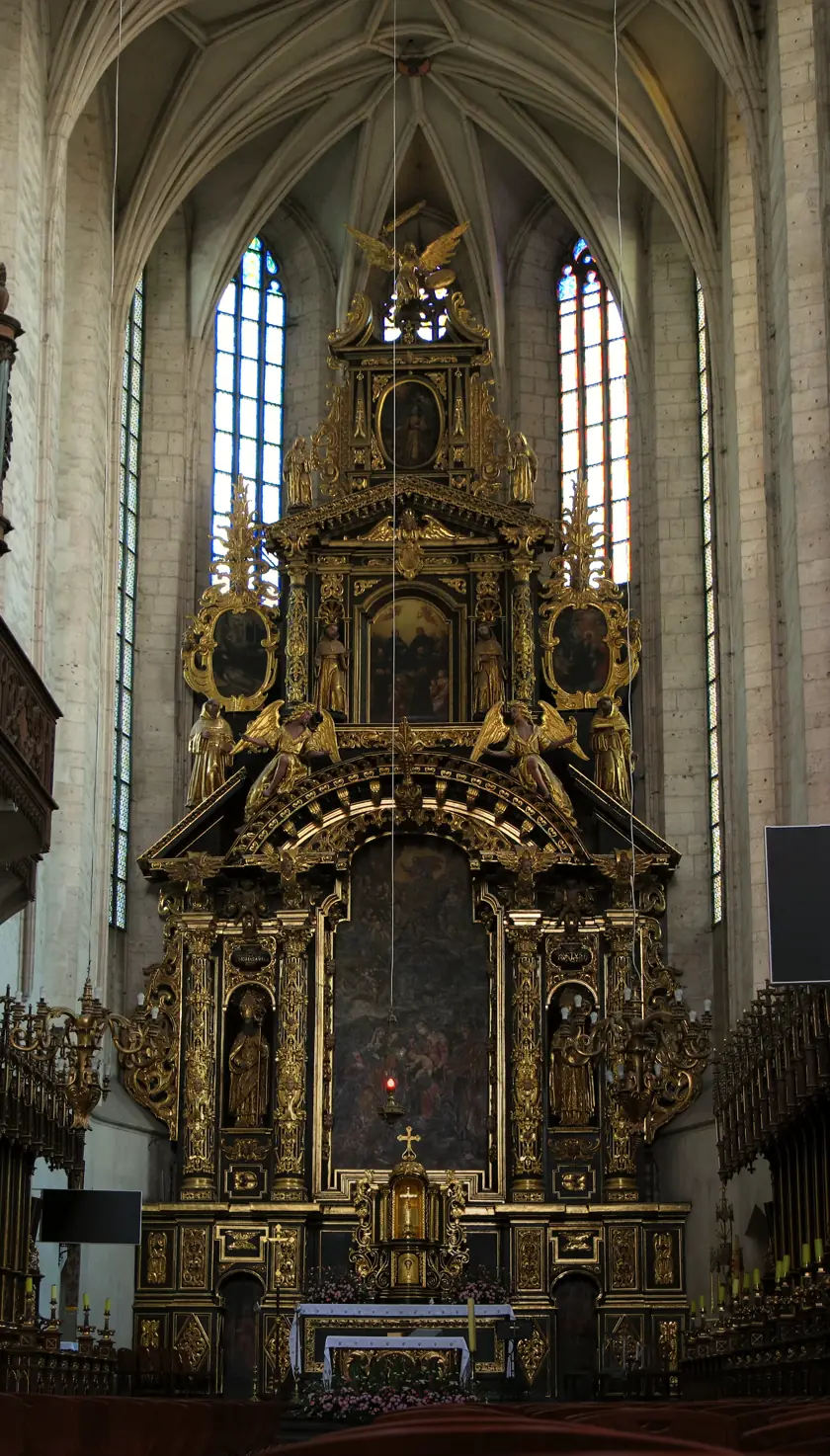
The Augustinian cloisters and the Gothic belfry
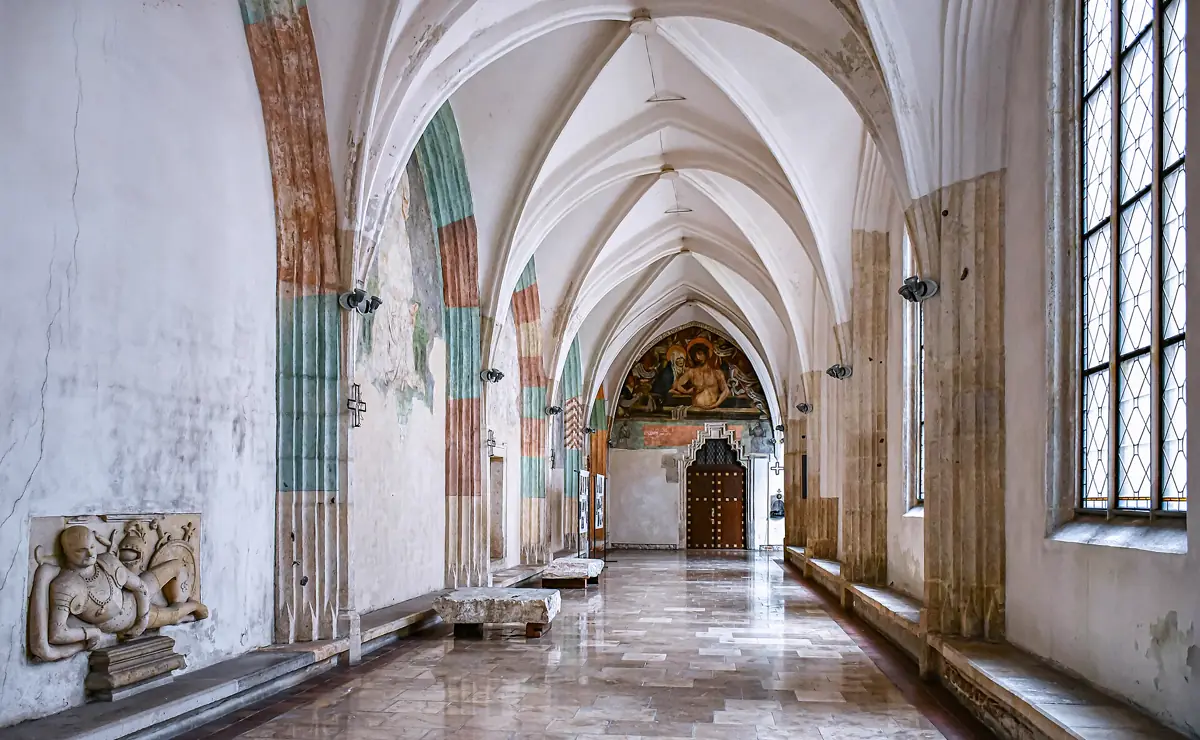
The Gothic monastery buildings adjoin the church on the north. Three wings, linked by cloisters (covered walkways), surround an inner garden, and the east wing extends to the line of the town's defensive wall. At the north end of the monastery wing, a Gothic tower of the Kazimierz town walls was adapted for the monastery.
Many paintings, stone carvings and plaques survive in the cloisters, mainly from the 15th and 16th centuries. In a chapel separated from the cloisters in the 17th century is an image of the Virgin Mary from the early 16th century, venerated as Matka Boska Pocieszenia (Our Lady of Consolation).
A free-standing belfry stands to the south-east of the church. Its Gothic brick base on a square plan dates from the early 15th century. The wooden upper part, in its present form, dates from the early 19th century.
History of the Church of St Catherine of Alexandria
The beginnings of the complex are linked with the founding of the town of Kazimierz by King Kazimierz Wielki (Casimir the Great) in 1335. The king most probably funded the church for Augustinian friars who were brought from Prague in 1342, according to the National Institute of Cultural Heritage. The oldest part of the monastery, the east wing with the chapel of St Dorothy, was finished in 1365, and twelve years later the cloisters were already standing.
By the consecration in 1378, the brick chancel with its stone details had been built, with the help of the Wawel building workshop. The nave was finished around 1400: instead of the planned hall church of five bays (with aisles as tall as the nave), a basilica of four bays was built. A new late Gothic star vault was built over the chancel after 1443, following an earthquake.
A fire in 1556 destroyed the interior of the church. Building and restoration work followed in 1561-1562, and the church was renovated in 1631. An earthquake in 1786 cracked the vaults, and in 1801 the Austrian authorities took over the church as a storehouse, which led to the devastation of its architecture and furnishings.
The church was restored several times, including in 1833-1835 and 1852-1864. Further restoration followed in 1893-1914, and thorough conservation work was carried out after 1989.
Augustinian martyrs and Father Izajasz Boner
Four Augustinians from the monastery, Father Wilhelm Gaczek and three companions, died in German Nazi concentration camps at Auschwitz and Dachau. Father Gaczek died in the German camp at Auschwitz in November 1941. According to the Augustinian order, their deaths were a consequence of the anti-Christian policy of persecution pursued by the German National Socialist regime. The parish calls them "our martyrs from the monastery of St Catherine of Alexandria".
A request to open their beatification process, the Catholic procedure that can lead to declaring a person blessed, was submitted in May 2017, and the process began in September 2018. The parish calls the four friars Servants of God and states that the process is under way.
Izajasz Boner was born in Krakow around 1400 and, as a young man, joined the Augustinian order at St Catherine's in Kazimierz. He studied abroad and at the Krakow Academy, where he became a professor of theology. He died on 8 February 1471 with a reputation for holiness, and the parish states that his canonisation process is under way.
Near the church: Skałka Sanctuary and the Jewish quarter
Plac Wolnica and the Ethnographic Museum are about 200 m from the church in a straight line. The Skałka Sanctuary and the Kazimierz Jewish Quarter are each about 250 m away, and the Chevra Tehilim Prayer House is about 300 m away. Our electric cart tour of Kazimierz goes through this district.
St Catherine's Church: questions visitors ask
Where is St Catherine's Church in Krakow?
On Augustiańska Street in Kazimierz. The Augustinian monastery complex lies on a roughly rectangular plot bounded by Paulińska Street to the north, Skałeczna Street to the south and Augustiańska Street to the east.
Who is buried in St Catherine's Church?
Father Izajasz Boner, an Augustinian who died in 1471. His remains rest in a mausoleum that was built in the church in the 18th century.
What is the chapel of St Monica in St Catherine's Church?
An unfinished stone chapel, funded by Ścibor ze Ściborzyc and built around 1400 on the foundations of a west bay that was planned but never built. Its rib vaults rest on a central pillar.
Photo: Jakub Hałun, Wikimedia Commons, CC BY-SA 3.0, cropped.
Other places worth seeing
Ready to explore?
Book a tour, hop on an electric cart, or arrange a transfer.