New Jewish Cemetery in Krakow: opening hours and graves
The Jewish cemetery on Miodowa Street, cared for by the Jewish Religious Community in Krakow, where the painter Maurycy Gottlieb and Rabbi Ozjasz Thon are buried.
19 min walk from the Main Market SquareDirections
Behind a brick pre-funeral house and a gate on Miodowa Street, the New Jewish Cemetery in Krakow (Nowy Cmentarz Żydowski) holds thousands of old matzevot, the traditional Jewish headstones, under tall trees. The Jewish Religious Community in Krakow looks after it and describes it as the only Jewish cemetery in Krakow still in use. The cemetery is open to visitors at set hours and closed on Saturdays and Jewish holidays.
The cemetery lies between the railway embankment and Miodowa, Siedleckiego and Daszyńskiego streets, about 250 m in a straight line from Szeroka Street.
What is at the New Jewish Cemetery today
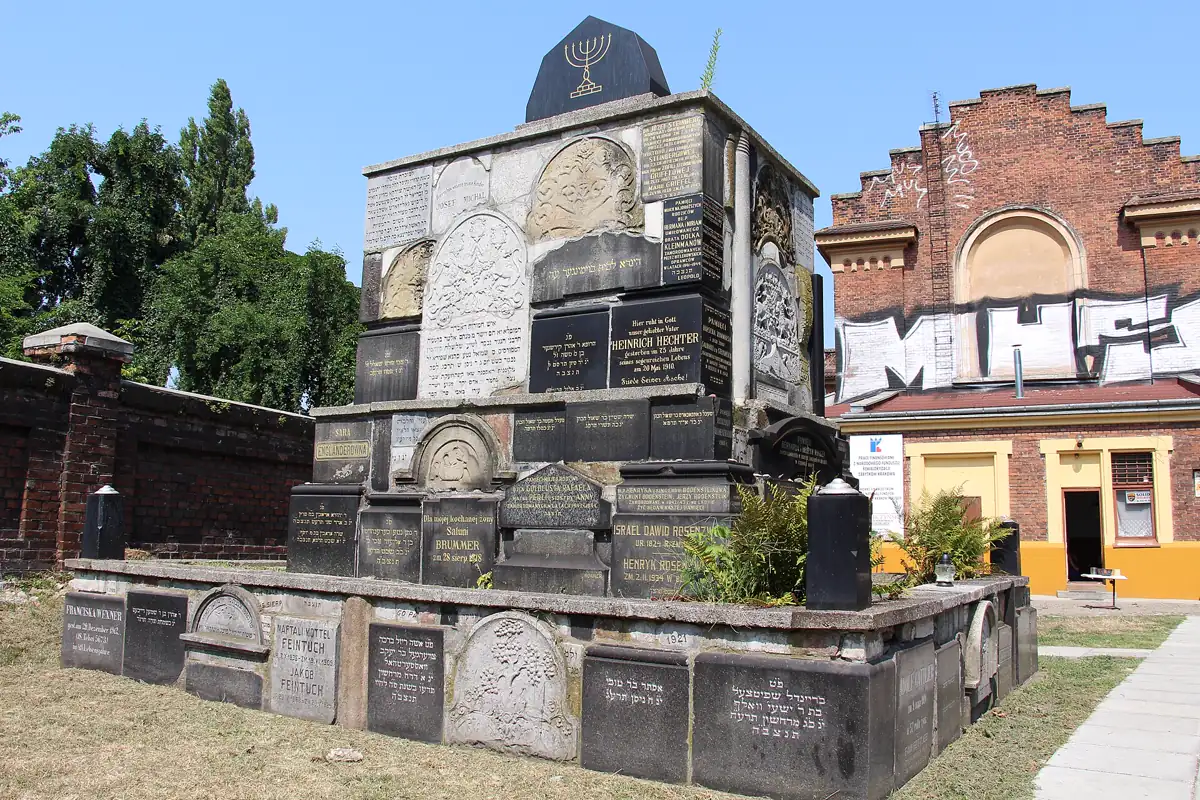
A memorial to the victims of the Holocaust stands by the main gate. Next to it is the brick pre-funeral house, designed by the Krakow architect Władysław Kleinberger and opened in June 1903. A wall surrounds the cemetery. Among the old matzevot and tall trees there are naturally overgrown alleys and paths with a hard surface.
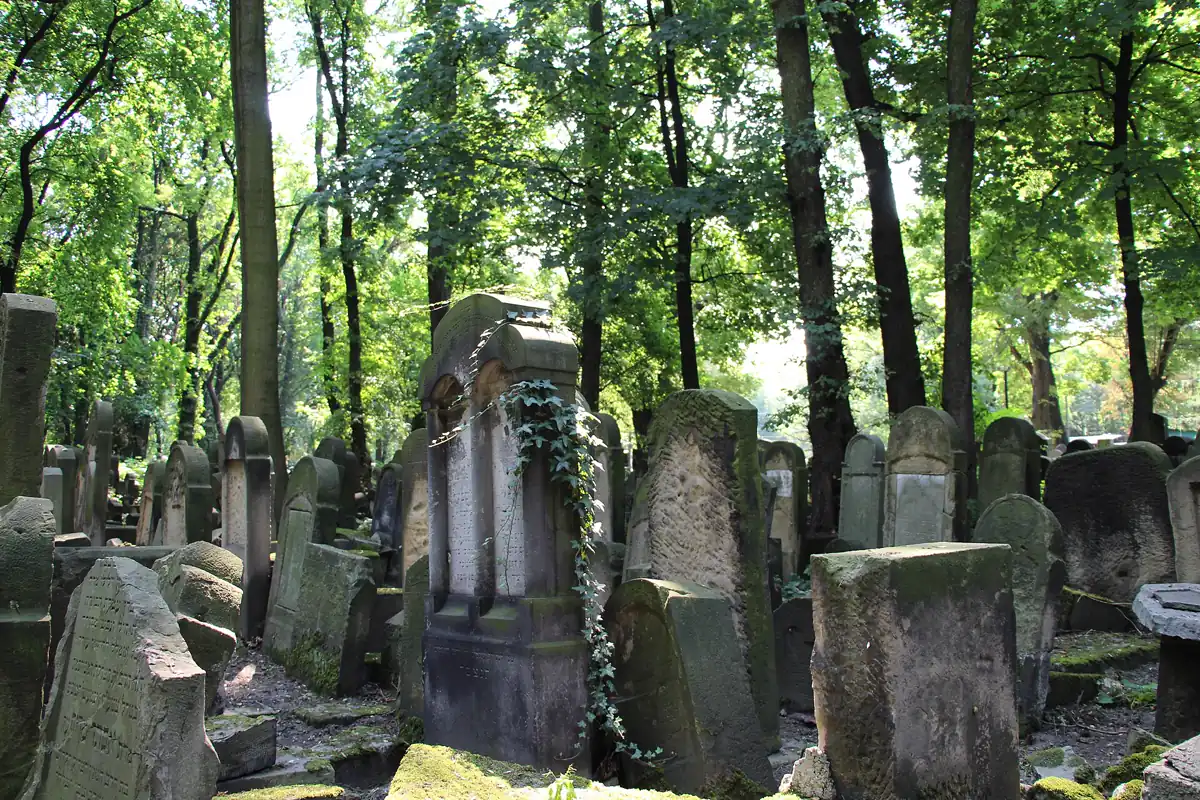
Many matzevot still bear Hebrew inscriptions and traditional Jewish symbols, such as crowns, lions, jugs, candlesticks and priestly hands. The symbols often show the origin, profession or religious role of the person buried there. The oldest surviving headstones date from the 19th century. Besides matzevot, there are headstones in the form of a sarcophagus, an aedicula (a small shrine-like structure), an obelisk and a column.
Several thousand headstones survive, according to the Museum of Krakow, while VisitMałopolska gives about 10 thousand. Some are of granite and others of Carpathian sandstone. According to VisitMałopolska, damaged headstones have been reconstructed and conserved for more than 20 years.
Who is buried in the New Jewish Cemetery
Rabbi Józef Kornitzer, Rabbi Ozjasz Thon and the tzaddik (Hasidic spiritual leader) Aron Elimelech are buried here, according to the Jewish Religious Community. The community also lists the painter Maurycy Gottlieb, the photographer Ignacy Krieger, Józef Sare, a deputy mayor of Krakow, and Professor Zofia Ameisen.
The musician Leopold Kozłowski, called "the last klezmer of Galicia", also rests here, as does Maciej Jakubowicz, president of the Congregation of the Mosaic Faith in Krakow. The Museum of Krakow adds the philologist Leon Sternbach and the painter Artur Markowicz.
History: from the Augustinians' land to the German occupation
The Jewish community bought the land from the Augustinians, outside the built-up area of Kazimierz at that time. The City of Krakow and the Museum of Krakow give 1800 as the year of foundation, and the Jewish Religious Community gives 1801. In 1836 the cemetery was enlarged with a piece of adjoining land. Between the two world wars it was no longer large enough, and in 1926 the community bought land for another cemetery in Wola Duchacka.
In 1939-1945 the cemetery was closed, and the Germans devastated it. The Germans used headstones from it for building work at the forced labour camp in Płaszów, today the KL Plaszow Memorial Site. After the war, many headstones were found on the site of the German camp and set up again in the cemetery.
The cemetery reopened after the war and was rebuilt with the help of the American Jewish Joint Distribution Committee. It was put in order after 1957, but the original layout of the burial sections was disturbed and is now hard to read. In 1999 the cemetery and its adjoining buildings were entered in the register of monuments.
Visiting the New Jewish Cemetery on Miodowa Street
According to the Jewish Religious Community in Krakow, the cemetery is open from Sunday to Friday, 10:00-16:00, and closed on Saturdays and holidays (as listed in October 2026). The hours can change with the season or because of holidays, so check them before your visit on the website of the Jewish Religious Community in Krakow.
This is a religious place: dress modestly, and men should cover their heads. Photography is allowed with respect for the graves, religious symbols and other visitors, and for professional photography or commercial filming it is advisable to get the consent of the cemetery administrator in advance. The grave lanterns seen on Christian cemeteries in Poland are not part of Jewish tradition; instead of flowers, visitors often leave a small stone as a sign of memory and respect.
Near the cemetery: the Great Mikveh and Popper Synagogue
The Great Mikveh is about 150 m from the cemetery in a straight line. The Popper Synagogue and the Jan Karski Bench are each about 200 m away.
New Jewish Cemetery: questions visitors ask
Where is the New Jewish Cemetery in Krakow?
At Miodowa 55. Its gate and pre-funeral house face Miodowa Street.
Is the New Jewish Cemetery the same as the old Jewish cemetery in Krakow?
No. The old cemetery is next to the Remuh Synagogue on Szeroka Street. According to the Jewish Religious Community, the Austrian authorities ordered it closed in 1800 for sanitary reasons.
When is the New Jewish Cemetery closed?
On Saturdays and Jewish holidays, as listed in October 2026.
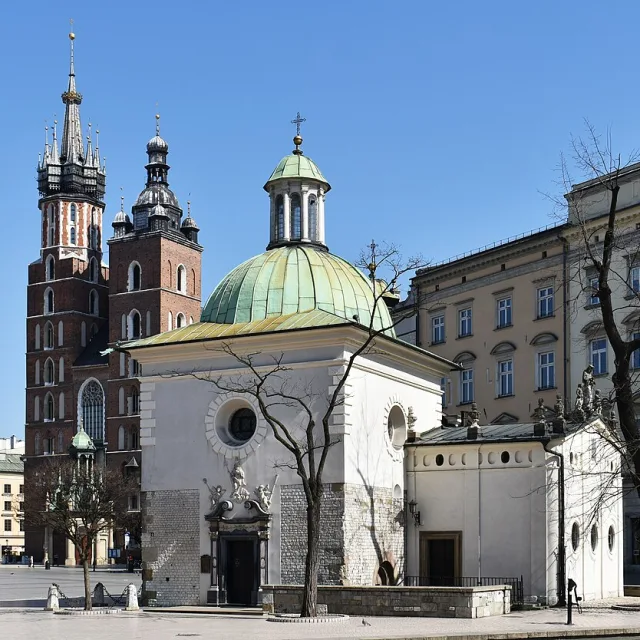
Photo: Dwxn, Wikimedia Commons, CC BY-SA 4.0, cropped.
Other places worth seeing
Ready to explore?
Book a tour, hop on an electric cart, or arrange a transfer.