Great Mikveh in Krakow: former ritual bath on Szeroka Street
A former Jewish ritual bath first recorded in 1567, whose building now houses Klezmer-Hois and the Austeria publishing house. Remains of the old pool survive in the cellars.
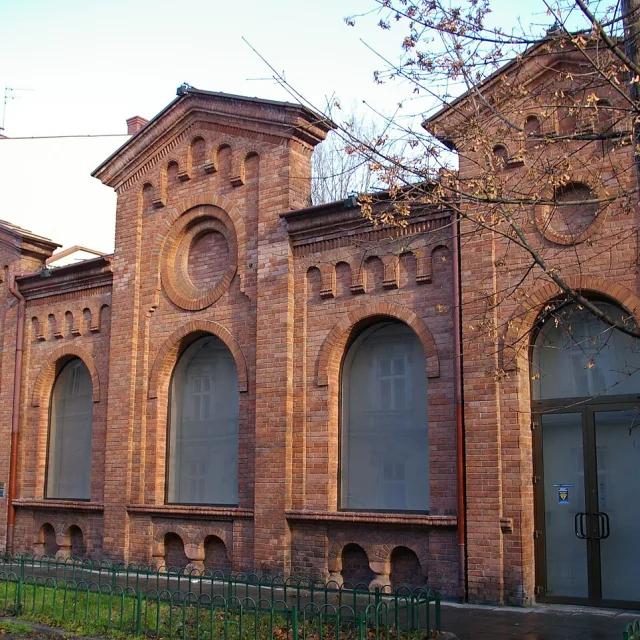
The Great Mikveh in Krakow, at 6 Szeroka Street in Kazimierz, no longer works as a ritual bath. Its building survives and houses the Klezmer-Hois restaurant and hotel and the Austeria bookshop. This former Jewish ritual bath, Mykwa Wielka in Polish, was first recorded in documents in 1567. The building can be visited if you ask the current manager beforehand.
Visiting the Great Mikveh on Szeroka Street
As a ritual bath, the Great Mikveh is no longer in use. The building can be visited. Before a visit, ask the current manager of the building whether a visit is possible.
The building is described by the City of Krakow in its text about Szeroka Street.
Klezmer-Hois and Austeria in the Great Mikveh building
Klezmer-Hois, which has a café, a restaurant, guest rooms and a bookshop, occupies the building of the former mikveh. The Austeria publishing house also has its bookshop and its seat in the building. Klezmer-Hois says that it was co-founded by Leopold Kozłowski, whom it calls the last klezmer (a traditional Jewish folk musician) of Galicia.
The building has walls of rubble stone, finished with plaster. Its central part has two storeys and contains the staircase. One ground-floor room has a ceiling supported on four pillars, and the way down to the pool is thought to have been in that room.
In the cellars, fragments of rubble-stone walls, parts of an arcade and the layout of the rooms survive. Remains of the old mikveh also survive underground, including parts of the ritual pool and of the system that brought water in and carried it away.
The pool that was fed by a spring, about 40 steps down
A mikveh (also spelled mikvah), also called a pool of purification, is a Jewish ritual bath used for immersion in line with Jewish religious law (halakha). The pool of this mikveh held water from a natural spring and lay deep below ground, under the level of the cellars. About 40 steep steps led down to the pool, because at that depth there was a spring with the water needed for ritual purification.
A bath attendant heated the bath at least once every two weeks and also on every Friday. The walls of the bathing area are said to have been lined with wood at first. Later, cement was among the materials used.
History of the Great Mikveh from 1567
A mikveh probably existed in Krakow as early as the turn of the 15th and 16th centuries. The first mention of the mikveh on Szeroka Street in documents dates from 1567. The statute of the Jewish community from 1595 mentions the building, together with a second mikveh near Plac Nowy. That second mikveh no longer exists. In the 17th century, the mikveh was called Wielka Mykwa, which means Great Mikveh.
The mikveh worked in the same place over the following centuries. The present appearance of the building dates from a thorough renovation in the early 19th century. After that renovation, the mikveh was renovated and modernised several more times. The bath worked until the outbreak of the Second World War.
During the occupation, the Germans devastated the mikveh. The cellar pool survived, but it was filled in together with the other cellar rooms. After the war, the users of the building included the Zjednoczenie Urządzeń Klimatyzacyjnych i Wentylacyjnych, a body whose name refers to air-conditioning and ventilation equipment.
On 7 July 1966 the building was entered in the register of monuments. Its register number is A-306. From 1974 to 1977 the building was extensively renovated and partly rebuilt. The work was carried out by Pracownia Konserwacji Zabytków, a monument conservation workshop, and the design was prepared by the architect Zdzisław Głąb.
During this work, the walls were strengthened, new ceilings were made and the roof structure was changed. The cellars were partly cleared of rubble, and disused inflow and drainage channels connected with the ritual pools were uncovered.
In the 1990s the property was returned to the Jewish Religious Community in Krakow (Gmina Wyznaniowa Żydowska w Krakowie). At first, the rooms on the first floor served as exhibition halls. In 1995 the Community agreed to place the Klezmer-Hois restaurant and hotel in the building. From 2004 to 2013 the BARAKAH theatre (Teatr BARAKAH) had its home in the building.
Remuh Synagogue, Popper Synagogue and the Karski bench nearby
The Jan Karski Bench is about 50 m away in a straight line. The Remuh Synagogue and its cemetery are about 100 m away. The Popper Synagogue is also about 100 m away.
Austeria has a second location at 16 Szeroka Street, in the Popper Synagogue, separate from its bookshop in the former mikveh. YourKrakow runs an electric cart tour of Kazimierz, the district where the former mikveh stands.
Great Mikveh: questions visitors ask
Which building on Szeroka Street was the Great Mikveh?
Number 6. The building at Szeroka 6, 31-053 Krakow, now houses Klezmer-Hois and the Austeria bookshop.
Is the Great Mikveh still used as a ritual bath?
No. The bath worked until the outbreak of the Second World War, and it no longer works as a mikveh.
Can you visit the Great Mikveh in Krakow?
Yes, but ask the current manager of the building about a visit beforehand.
When was the Great Mikveh first recorded?
In 1567, the year of its first mention in documents. The present appearance of the building comes from the early 19th century.
Photo: Jeremiah Z. Cockroach, Wikimedia Commons, CC BY-SA 4.0, cropped.
Other places worth seeing

Ready to explore?
Book a tour, hop on an electric cart, or arrange a transfer.