Plac Wolnica and the Ethnographic Museum in Krakow
Part of the old market square of Kazimierz, named after the right of free trade, with a town hall that certainly stood by 1369 and a fountain with three musicians.
23 min walk from the Main Market SquareDirections
On Plac Wolnica in Krakow, part of the old market square of the town of Kazimierz, the former Kazimierz town hall houses the permanent exhibition of the Ethnographic Museum (Muzeum Etnograficzne w Krakowie). The exhibition shows various aspects of the vanished world of the Polish village. The square itself is a public space, so you can walk across it at any time; there is no ticket.
The square lies in the historic district of Kazimierz, about 50 m in a straight line from the Kazimierz Jewish Quarter.
Visiting the Ethnographic Museum in the former town hall
The permanent exhibition is in the former town hall at Plac Wolnica 1. The museum shows its temporary exhibitions in another building, the Dom Esterki at Krakowska 46. On its "Zaplanuj wizytę" (Plan your visit) page, the museum offers a guide to the town hall building and the visiting rules to download before a visit.
Current visiting arrangements are listed on the website of the Ethnographic Museum. Our electric cart tour of Kazimierz also goes through this district.
What to see in the Ethnographic Museum
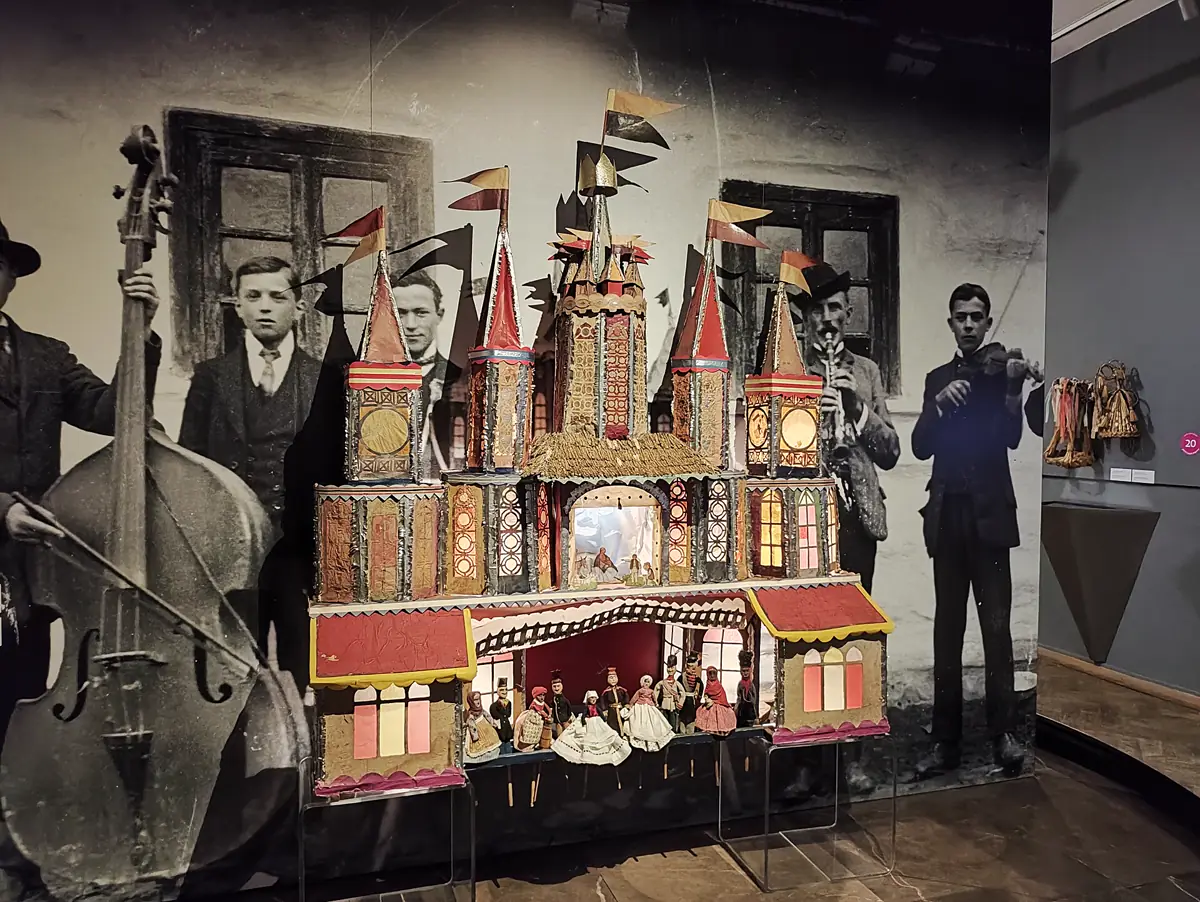
The objects in the permanent exhibition come from different ethnographic regions of Poland. They are grouped into micro-histories about the stages of human life and about people's relationship to nature, work, the home, creativity, religion, ritual and other people. Generations of museum staff and visitors have searched the exhibition for an answer to one question: "How does a person organise their reality?"
The museum suggests six ways of seeing the permanent exhibition, under the Polish titles Od środka, Rytm życia, Rzeczy ludzkie, Kogo stać?, Od-nowa and Nieobjęta ziemia. Part of the first permanent exhibition, created after the war under the director Tadeusz Seweryn, can still be seen, and the museum says that it now has historical value.
The film "Pucheroki", from the series "Zwyczaje wielkanocne", was shot with a camera bought in 1946 on the initiative of Roman Reinfuss. It can be seen in the museum, in the exhibition on spring rituals. Since its foundation, the museum has enlarged its collections to more than 80 thousand objects, shown in the permanent exhibition and in many temporary exhibitions.
Plac Wolnica and the old market square of Kazimierz
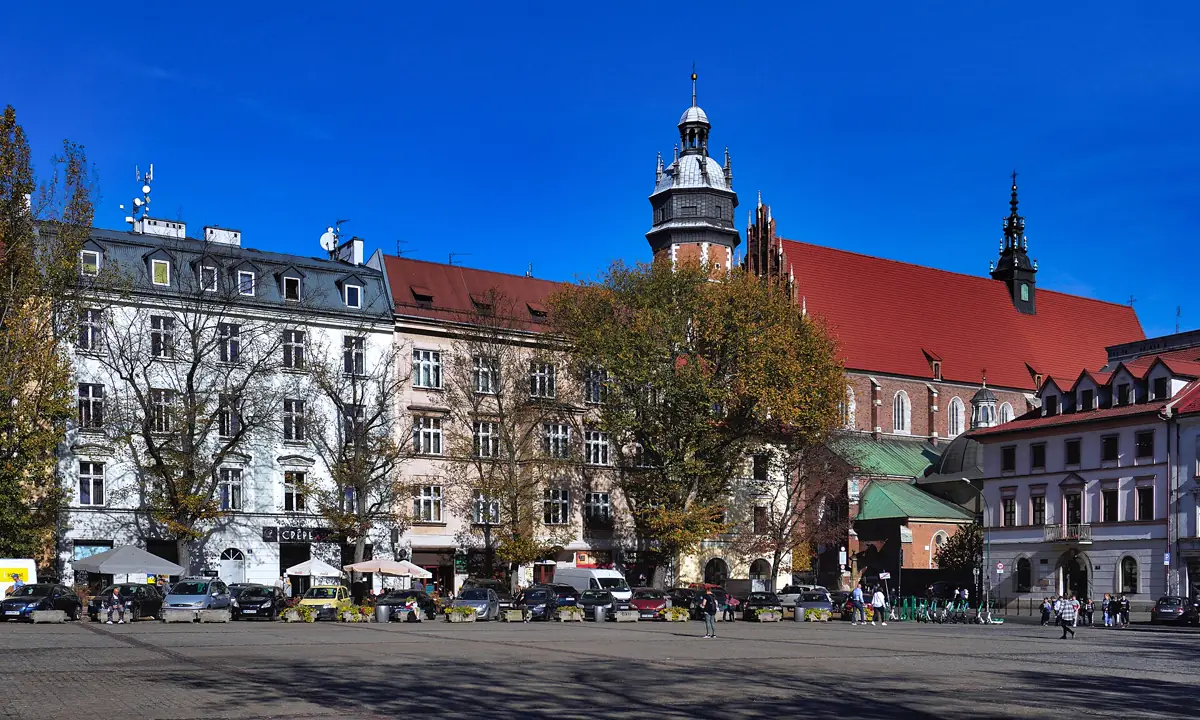
The name Wolnica comes from the Latin forum liberum, the right of free trade. Once a week it allowed merchants to sell meat outside the butchers' stalls. The name Plac Wolnica itself became established only in the 19th century.
The market square of Kazimierz was laid out soon after the town was founded, and it was much larger than today's Plac Wolnica: a square with sides of 195 m. It reached today's Augustiańska Street in the west and the line of Skawińska Street and the Dom Esterki in the south. The salt trade route towards Wieliczka and Bochnia ran through the middle of the market square, along today's Krakowska Street.
The town hall stood in the middle of the northern part of the market square, and on its south side was a cloth hall built before 1385. After Kazimierz was joined to Krakow in 1800, new street lines were drawn, and Plac Wolnica received its present boundaries. In 1970 a fountain with the sculpture "Trzej grajkowie" (Three Musicians) by Bronisław Chromy was set up on the square. A plaque in the east wall of the town hall commemorates the arrival of Jews in Poland.
History of the Kazimierz town hall
The history of Kazimierz as a separate town began with the foundation charter that King Kazimierz Wielki (Casimir the Great) issued on 27 February 1335. The town, named after its founder, was to use German law in its Magdeburg form. The town hall was probably built soon after the town was founded. It certainly existed in 1369, when the town accounts recorded a payment of 5½ grzywna (a medieval unit of money) for a town hall bell.
Historians believe, and the museum finds it very probable, that the first town hall was wooden and that a new masonry one replaced it at the beginning of the 15th century. The walls of the ground and first floors in the northern part of the building very probably date from the Gothic period. The town hall burned in 1528 and was rebuilt. In 1578 a kitchen was built, and the tower was erected or raised.
After another fire in 1623, the town hall was rebuilt again, probably with a second floor and an attic, a decorative wall above the roof line. The oldest known image of the building, dated by researchers to 1603-1605, appeared in the sixth volume of "Civitates orbis terrarum" by Georg Braun and Frans Hogenberg, published in Cologne in 1617. There the town hall is labelled with the Latin word Praetorium.
When Kazimierz was finally joined to Krakow in 1800, the town lost its autonomy, and the town hall lost its original functions. According to the "Gazeta Krakowska" of 1805, the building was put up for public auction twice, but neither sale took place. In 1820 the elementary school at Corpus Christi Church moved into the former town hall, and in May 1831 a primary school for Jewish children opened on its second floor. The city authorities date a major rebuilding to 1876.
The Ethnographic Museum opened on 19 February 1911, thanks to the efforts of Seweryn Udziela, and in 1913 its collections moved to the former seminary of St Michael at Wawel. When the Second World War broke out, the collections numbered 30 thousand objects, and the invasion by Nazi Germany threatened the removal of part of them to the Reich. They survived the German occupation almost unharmed, and only several hundred objects were lost.
In 1945 the Ethnographic Museum Society handed the collections over to the state, and in 1948 they received a new home in the former Kazimierz town hall. The building was obtained by Tadeusz Seweryn, Udziela's successor, who worked at the museum from 1930 and was its director in 1938-1965. Seweryn was named Righteous Among the Nations. Under the director Edward Waligóra the building had a general renovation, and a new permanent exhibition opened in 1969.
Near the square: Corpus Christi Church and St Catherine's
Corpus Christi Church is about 150 m from the square in a straight line, and St Catherine's Church is about 200 m away. The Chevra Tehilim Prayer House is about 300 m away.
Plac Wolnica and the Ethnographic Museum: questions visitors ask
Where is Plac Wolnica in Krakow?
In Kazimierz. Plac Wolnica is part of the old market square of the town. The former town hall at Plac Wolnica 1 stands on the square.
Where does the Ethnographic Museum show temporary exhibitions?
In the Dom Esterki at Krakowska 46, a historic building the museum received in 1986. The permanent exhibition stays in the town hall.
When did the Ethnographic Museum move into the Kazimierz town hall?
In 1948, three years after the Ethnographic Museum Society handed its collections over to the state.
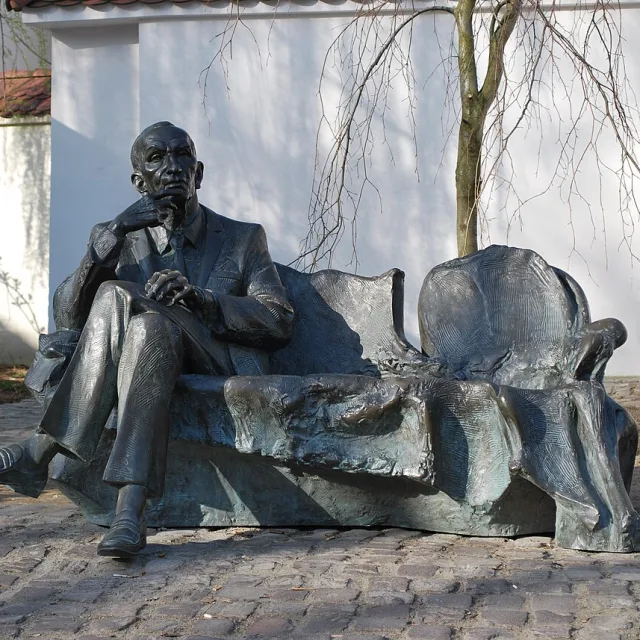
Photo: Marcin Konsek, Wikimedia Commons, CC BY-SA 4.0, cropped.
Other places worth seeing
Ready to explore?
Book a tour, hop on an electric cart, or arrange a transfer.