Dominican Basilica in Krakow: Masses, St Hyacinth's Chapel
The Dominicans received this church in 1222. It holds the burial chapel of St Hyacinth (Jacek Odrowąż), a bronze tomb slab designed by Wit Stwosz and, in the friary, the Dominican Museum.
6 min walk from the Main Market SquareDirections
Dominican friars run the Dominican Basilica in Krakow, the church of the Holy Trinity on Stolarska Street, about 200 m in a straight line from the Little Market Square (Mały Rynek). Its Polish name is Bazylika Świętej Trójcy. The friars hold Masses in the Dominican church on Sundays and on other days. In the friary next door, the Dominican Museum takes visitors who book in advance.
- Address: Stolarska 12, 31-043 Krakow.
- Mass times: on days other than Sundays and holidays the first Mass is at 7.00 and the last at 19.30; on Sundays and holidays the last Mass is at 21.30 (as listed in October 2026).
- Museum: entry with a free ticket for a specific day and time (as listed in October 2026).
Masses at the Dominican Basilica
On Sundays and holidays, Mass is celebrated at 8.00, 9.00, 10.30 and 12.00. Afternoon Masses follow at 13.30, at 15.30 (except in July and August) and at 17.00. In the evening there is a Mass for young people at 19.00, a Mass for university students at 20.20 and a last Mass at 21.30.
On days other than Sundays and holidays, Masses are at 7.00, 8.00, 9.00, 12.00 and 19.30. There is also a Mass at 17.00, and a rosary service follows it every day. These are times of services, not visiting hours.
The basilica is a double sanctuary, of Our Lady of the Rosary and of St Hyacinth (Jacek Odrowąż), according to VisitMałopolska. The feast of Our Lady of the Rosary falls on 7 October, and the memorial of St Hyacinth on 17 August.
Times can change; check the current details on the Dominican friars' website before your visit.
What to see inside the Dominican Basilica
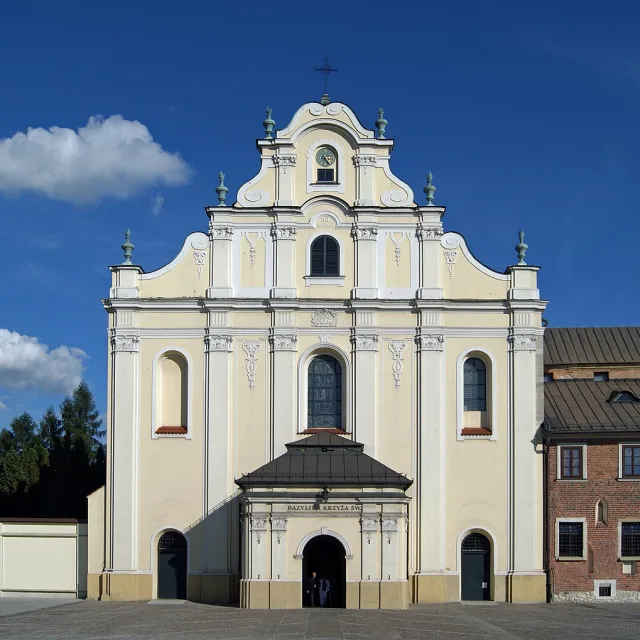
The façade ends in a stepped gable decorated with coats of arms. You enter through a Neo-Gothic porch, which shelters the Gothic main portal from about 1400, a pointed doorway with rich carved decoration. The Dominicans describe the church as a brick Gothic basilica with three aisles and five bays, 37 m long and 23 m wide.
The church has Neo-Gothic furnishings, and the chapels keep their Baroque fittings. In the chancel, the area around the high altar, lies the bronze tomb slab of Filip Kallimach, a humanist who died in 1496. It was made to a design by Wit Stwosz (Veit Stoss). Prince Leszek Czarny (Leszek the Black), who died in 1288, is buried beside the high altar.
The organ was built in 1890 by the firm of the Rieger brothers from Jägerndorf as their opus 756, and it has 30 stops.
St Hyacinth's Chapel and the Rosary Chapel
The burial chapel of St Hyacinth Odrowąż (c. 1183-1257) was built in the 17th century on the model of the Sigismund Chapel (Kaplica Zygmuntowska) at Wawel. The city authorities count it among the most outstanding works of this kind in Poland. The saint's remains rest in a late Baroque tomb on the altar.
Baldassarre Fontana made the altar in 1695-1703, and about 1700 he also decorated the chapel with stucco. The scenes from the life of the saint were painted by Tomasz Dolabella, a Venetian painter who worked in the circle of the Vasa court.
The city authorities single out the Chapel of Our Lady of the Rosary, a votive offering for the victory at Vienna. It was built in 1685-1688 on the plan of a Greek cross with a dome. According to VisitMałopolska, it adjoins the right-hand side aisle.
By tradition, the painting of Our Lady of the Rosary in the chapel belonged to St Stanislaus Kostka, the Dominicans say. VisitMałopolska writes that it was made in Rome as a copy of the image in the church of Santa Maria Maggiore. Since 1983 the chapel has been the burial place of Teofila Sobieska, mother of King Jan III Sobieski, and of his brother Marek Sobieski.
In the Chapel of the Crucified Jesus, fragments of Gothic paintings from the end of the 14th century survive. Dolabella was buried in this chapel in 1650.
The friary, cloisters and Dominican Museum
The friary buildings stand around three courtyards and were built from the 13th century onwards. Their oldest part is the Romanesque refectory, the friars' dining hall, built of rough stone. The cloisters, covered walkways around a garden courtyard, are a burial place of friars and of people linked with the order. Their walls carry many epitaphs and portraits of Polish Dominican bishops from the 13th to the 15th centuries.
Entry to the Dominican Museum requires a free ticket, booked in advance for a specific day and time (as listed in October 2026). The exhibition fills the ground floor and the medieval cellars, which were made deeper for the museum. The museum points to its Romanesque walls and a Gothic hypocaust, an under-floor heating system.
The museum calls its most valuable item a set of stained-glass panels from the turn of the 13th and 14th centuries, which it describes as the oldest in Poland. It also has two leaves of the oldest known copy of the first life of St Hyacinth, written about 1360. A gold monstrance from the friary in Podkamień has a wreath that tradition links with the wedding of Queen Bona.
History of the Dominican Basilica of the Holy Trinity
The Dominicans came to Krakow in 1222 through the efforts of Iwo Odrowąż, then Bishop of Krakow. According to VisitMałopolska, the bishop gave the friars and St Hyacinth the parish church of the Holy Trinity, then partly wooden and partly brick. St Hyacinth, who received the habit from St Dominic, was the direct founder of the Polish Province of the Dominicans.
The present church is a medieval building, built from the 13th century onwards. The great fire of 1850 destroyed the church, its tower and part of the friary. VisitMałopolska adds that the fire burnt almost the whole interior and that the vault of the nave collapsed. The church was rebuilt after the fire, and it is entered in the register of monuments.
Dominican life in this friary has continued without a break since the first years of the order, the friars say, and they count it as one of three such friaries in the world. A higher school, the Studium Generale, has trained young friars here for more than 600 years, according to the friars. About 70 friars live in the friary today, according to the Dominicans, among them almost 30 theology students from Poland, Ukraine and Belarus.
Franciscan Basilica and St Adalbert's Church nearby
Distances below are measured in a straight line. St Adalbert's Church and the Pod Temidą milk bar are each about 200 m from the Dominican Basilica. The Franciscan Basilica is about 250 m away.
Dominican Basilica: questions visitors ask
Who is buried in the Dominican Basilica?
St Hyacinth Odrowąż rests in his chapel, and Prince Leszek Czarny beside the high altar. Teofila Sobieska and Marek Sobieski lie in the Rosary Chapel, and the painter Tomasz Dolabella in the Chapel of the Crucified Jesus.
Where is the Dominican church in Krakow?
On Stolarska Street, at number 12. The friary buildings stand next to the church, around three courtyards.
Can you visit the Dominican Museum in Krakow?
Yes, with a free ticket booked in advance for a specific day and time, as listed in October 2026. The exhibition is on the ground floor and in the medieval cellars of the friary.
Photo: Zygmunt Put Zetpe0202, Wikimedia Commons, CC BY-SA 4.0, cropped.
Other places worth seeing
Ready to explore?
Book a tour, hop on an electric cart, or arrange a transfer.