Mogiła Abbey in Krakow: Samostrzelnik paintings and museum
A Cistercian abbey founded in 1222, with a brick basilica from the time between Romanesque and Gothic, a 15th-century crucifix and a museum in the former abbot's palace.
Outside the city centreDirections
At Mogiła Abbey in Krakow, the Cistercian abbey church has been a place of devotion to Christ Crucified since the 15th century. The abbey, Opactwo Cystersów w Mogile in Polish, was founded in 1222 and stands on Klasztorna Street, about 1200 m in a straight line from Wanda Mound. The monks invite guests to the basilica, the cloisters and the monastery garden, and a museum in the former abbot's palace sells tickets.
- Address: Klasztorna 11, 31-979 Krakow.
- Museum: standard ticket 10 PLN, reduced ticket 5 PLN, according to the city tourism website krakow.travel (as listed in October 2026).
- Getting there: coaches park by the monastery, entering through the gate; from the Wieliczka side you can cross a bridge over the Vistula.
Visiting Mogiła Abbey: basilica, cloisters and garden
The abbey invites guests to the chapel of Pan Jezus Mogilski (the Lord Jesus of Mogiła), known for graces received there, and to the basilica. Guests can also see the cloisters, the chapter house (the room where the monks met), the former calefactory (the heated room), the fraternity room, the abbot's chapel and the monastery garden. The former parish church of St Bartholomew is also open to visitors.
The two-storey monastery, built as a quadrangle in the third quarter of the 13th century and extended many times, adjoins the church on the south side. Its cloisters surround a garth, an enclosed garden. At the back of the complex stands a round 17th-century tower with loopholes, which is what remains of the old fortifications.
The John Paul II Garden was created on the site of the former enclosure garden, which was thoroughly changed after 1979. It is open to the faithful and has a field altar in the form of an open chapel.
Organised groups visit the monastery after booking in advance. A group reports its arrival at the monastery gate (furta) and waits there for a guide from the abbey.
Current visiting arrangements are listed on the Mogiła Abbey website.
What to see inside the Mogiła Abbey basilica
The church is a brick basilica with three aisles and a transept, built on the plan of a Latin cross, with pointed arcades between the aisles. It comes from the period between Romanesque and Gothic: it was already built in the Gothic style, but it has many Romanesque elements, especially in the stone details. According to the abbey, it is one of the oldest brick buildings in Poland.
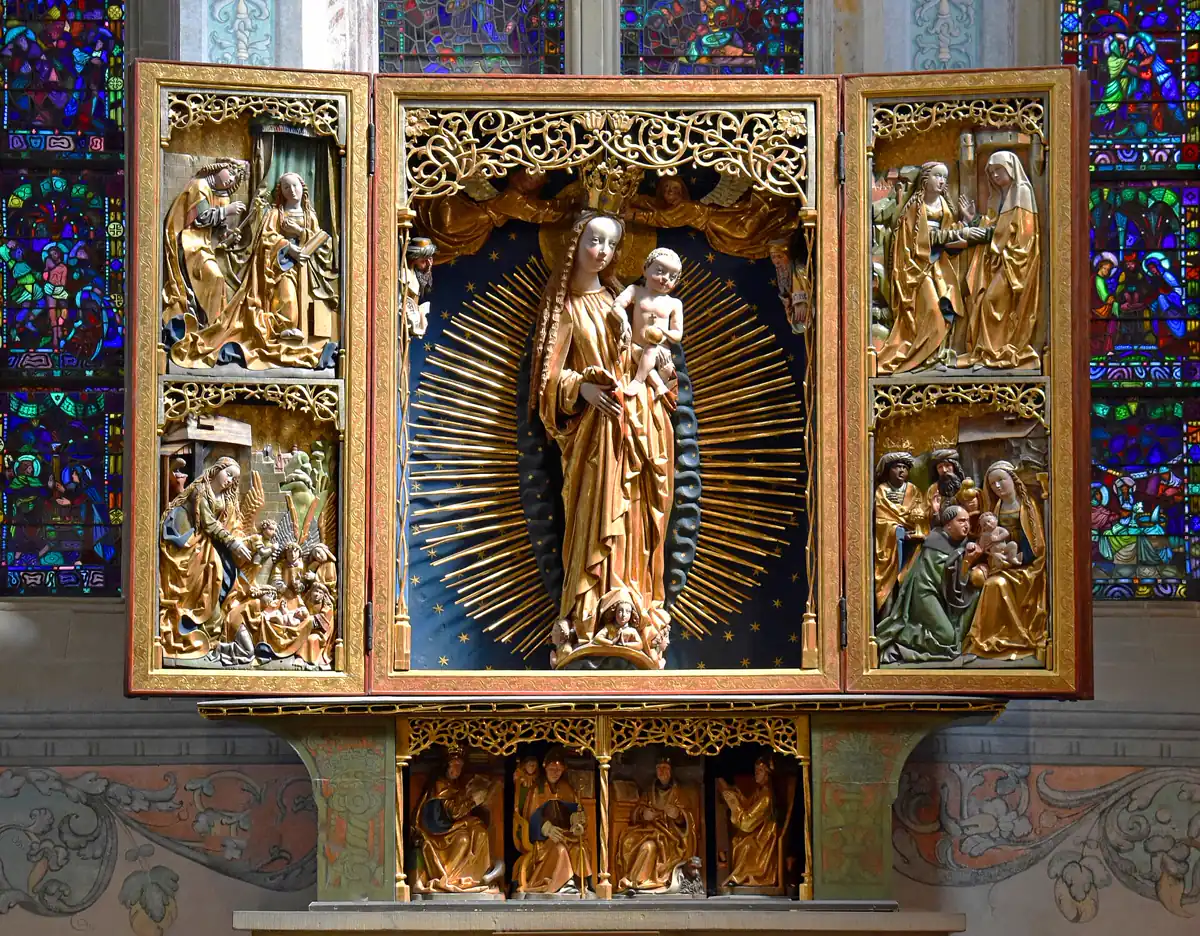
The chapel of Pan Jezus Ukrzyżowany (the Crucified Lord Jesus) holds a crucifix from the first half of the 15th century. In the high altar stands a late Gothic polyptych of 1514 from Ścinawa. A polyptych is an altarpiece made of several painted panels. The 18th-century frescoes in the Holy Cross Chapel show Old Testament scenes that foretell the sacrifice of Christ on the cross.
A stone Romanesque-Gothic portal with columns between the cloisters and the nave, fragments of a Romanesque ceramic floor in the chancel and a late Romanesque brick piscina date from the 13th century. The Baroque period left altars from the 17th century and choir stalls from the first half of the 18th century. Jan Bukowski (died 1943) painted the vaults of the nave and the side aisles, and the National Institute of Cultural Heritage dates his nave paintings to 1916.
Renaissance paintings by Stanisław Samostrzelnik
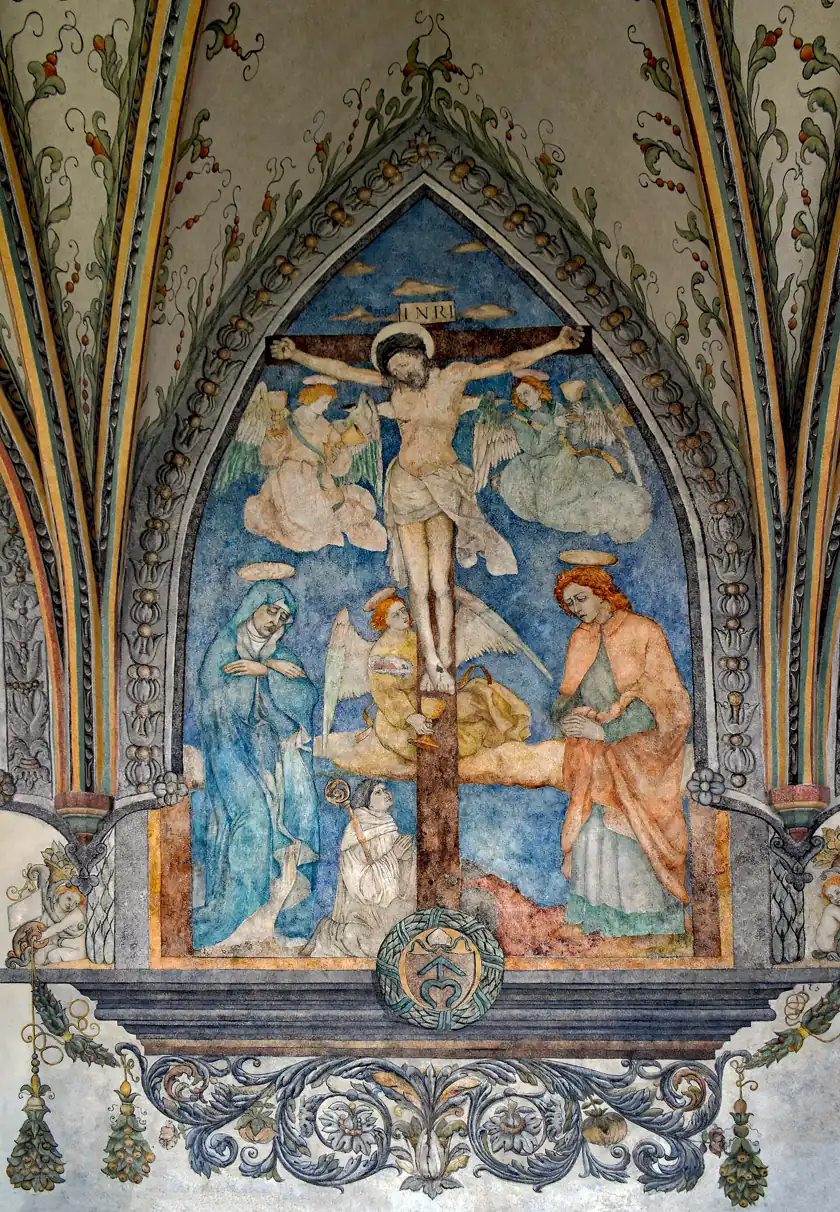
The figural Renaissance paintings in the chancel date from the second quarter of the 16th century. The Institute names their author as the Cistercian Stanisław Samostrzelnik. According to the abbey, Brother Stanisław, a Cistercian of Mogiła, painted the Annunciation in the chancel, the Crucifixion above the sacristy and plant ornaments in 1536-1538.
The 14th-century cloisters keep fragments of his paintings, with a monumental Crucifixion from 1538. The largest overall conservation of the church, in the second half of the 20th century, uncovered his Renaissance paintings and many Romanesque and Gothic parts of the building. His paintings in the monastery library and in the cloisters were conserved in 2005-2008.
The Cistercian museum in the former abbot's palace
The Muzeum Duchowości i Kultury Cystersów (museum of Cistercian spirituality and culture) opened on Saturday, 23 October 2021, after more than five years of work. It is in the former abbot's palace and priory. It shows the most valuable works of art owned by the abbey and the most valuable objects from the monastery library.
Part of the exhibition is multimedia, with models of Cistercian buildings, many of them interactive, a reconstruction of a 12th-century stained-glass window, animations and films. According to krakow.travel, a standard ticket costs 10 PLN and a reduced ticket 5 PLN (as listed in October 2026). The abbey refers visitors to the museum's own website for its days and hours.
History of Mogiła Abbey and the Odrowąż family
The foundation charter was issued in 1222, and the abbey dates the arrival of the Cistercians and the start of building to the same year. According to the National Institute of Cultural Heritage, the Odrowąż family first brought the monks from Pforta in Saxony and Lubiąż in Silesia to Kacice near Słomniki, and in 1225 the monks moved to the village of Mogiła, which Bishop Iwo Odrowąż had given them.
Iwo Odrowąż, Bishop of Krakow from 1218, led the building work. Prandota, the second bishop of Krakow from the Odrowąż family (from 1242), played the main part in completing the church and the monastery. In his time, perhaps with his money, the church received a richly decorated glazed ceramic floor.
Until the 16th century members of the Odrowąż family were buried in the crypt of the church. The last of them buried here was Jan z Krużlowej, starosta of Sącz, who died in 1532. After a great fire in 1708, the original vault of the nave was rebuilt in the Baroque style. The badly damaged church was rebuilt in the Baroque style in 1759-1764 and 1769-1775.
Franciszek Mosler from Opawa (Opava) rebuilt the façade and porch in 1780, and the Institute calls this the final stage of the Baroque rebuilding. In 1970 Pope Paul VI gave the church the title of minor basilica, an honorary title granted by the pope.
Central Square and Nowa Huta Reservoir nearby
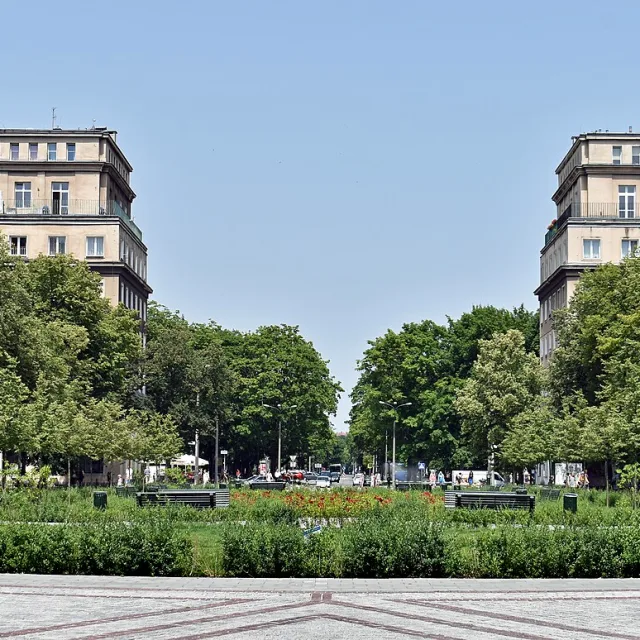
Mogiła is now part of Nowa Huta, a district of Krakow. Distances below are measured in a straight line. Central Square (Plac Centralny) is about 1400 m from the abbey, and Bar Mleczny Centralny, a milk bar, is about 1500 m away. Nowa Huta Reservoir (Zalew Nowohucki) is about 1600 m away.
Mogiła Abbey: questions visitors ask
When was the Mogiła Abbey church consecrated?
On 5 May 1266. Bishop Prandota consecrated it four months before his death and dedicated it to Our Lady of the Assumption and St Wenceslas.
Who painted the walls and vaults of Mogiła Abbey?
Stanisław Samostrzelnik, a Cistercian of Mogiła, painted in the chancel, above the sacristy and in the cloisters in the 16th century. Jan Bukowski painted the vaults of the nave and the side aisles.
How big is the library at Mogiła Abbey?
The library has 15 thousand volumes, and the monastery also keeps an archive. They include the world chronicle of Hartmann Schedel from 1493 and chronicles of the abbey from the 16th and 17th centuries.
Photo: Zygmunt Put Zetpe0202, Wikimedia Commons, CC BY-SA 4.0, cropped.
Other places worth seeing
Ready to explore?
Book a tour, hop on an electric cart, or arrange a transfer.