Botanical Garden in Krakow: opening hours and glasshouses
The Jagiellonian University's garden, founded in 1783, with an arboretum, alpine gardens, tropical glasshouses and a museum of about 5000 botanical objects.
20 min walk from the Main Market SquareDirections
Founded in 1783, the Botanical Garden in Krakow grows thousands of plant specimens on about 10 hectares at Kopernika 27, near Rondo Mogilskie. It belongs to the Institute of Botany of the Jagiellonian University and uses the English name Botanic Garden of the Jagiellonian University. The garden is open every day with a ticket, and its glasshouses and museum keep shorter hours.
- Address: Kopernika 27, 31-501 Krakow.
- Opening hours: garden every day from 9:00; from November to February until 15:00 (as listed in October 2026).
- Tickets: reduced, family, season and annual tickets are available; children under 4 enter free of charge (as listed in October 2026).
- Museum: Tuesday to Sunday, 10:00-14:45, all year (as listed in October 2026).
- Getting there: trams to Rondo Mogilskie, buses to Lubicz; the garden has no car park.
Botanical Garden opening hours and tickets
As listed in October 2026, the garden and its ticket office open every day at 9:00. From November to February the garden is open until 15:00, and the ticket office until 14:15. In March and October the garden closes at 17:00 and the ticket office at 16:15.
From April to August the garden is open until 19:00, and the ticket office until 18:15. In September the garden closes at 18:00 and the ticket office at 17:15. The garden is closed every year on 1 November, from 24 to 26 December, on 31 December and on 1 January.
The museum and the glasshouses open at 10:00, from Tuesday to Sunday. The museum closes at 14:45 all year, and the glasshouses close at the same time from November to March. From April to August the glasshouses close at 18:30, and in September at 17:45. In October they close at 16:45.
On Mondays the museum and all glasshouses except the Warszewicz Orangery are closed. Children under 4 enter free of charge. A reduced ticket is for children from the age of 4, young people and students up to 26, and pensioners with a valid ZUS card from the Polish pension office.
A family ticket is valid for 1 day for two adults with two children under 16. The season ticket is personal and valid from the beginning of April to the end of October, and the annual ticket is personal and valid for the whole calendar year. People with a Polish disability certificate enter free, in some cases with a carer.
The educational ticket is for organised groups, includes a guide from the garden and must be booked in advance. You pay in cash or by card at the ticket office, or online at bilety.uj.edu.pl, and you show the ticket whenever the staff ask for it.
Hours and prices change; check the current details on the Jagiellonian University Botanic Garden website before your visit.
What to see in the Botanical Garden: glasshouses and arboretum
The arboretum, a collection of trees and shrubs, covers the largest area, and part of it is laid out as a landscape park. Its trees are arranged in geographical groups, for example from East Asia and North America, and in ornamental groups such as the collection of lilacs.
The grounds are divided into several sections, among them plant systematics, protected and endangered plants of Poland, genetics and variability, flower ecology, and morphology and ecology. Visitors take a particular interest in the medicinal plants section, which also has other useful plants, such as vegetables, fruit, spices, and plants that give fibre, dyes or honey.
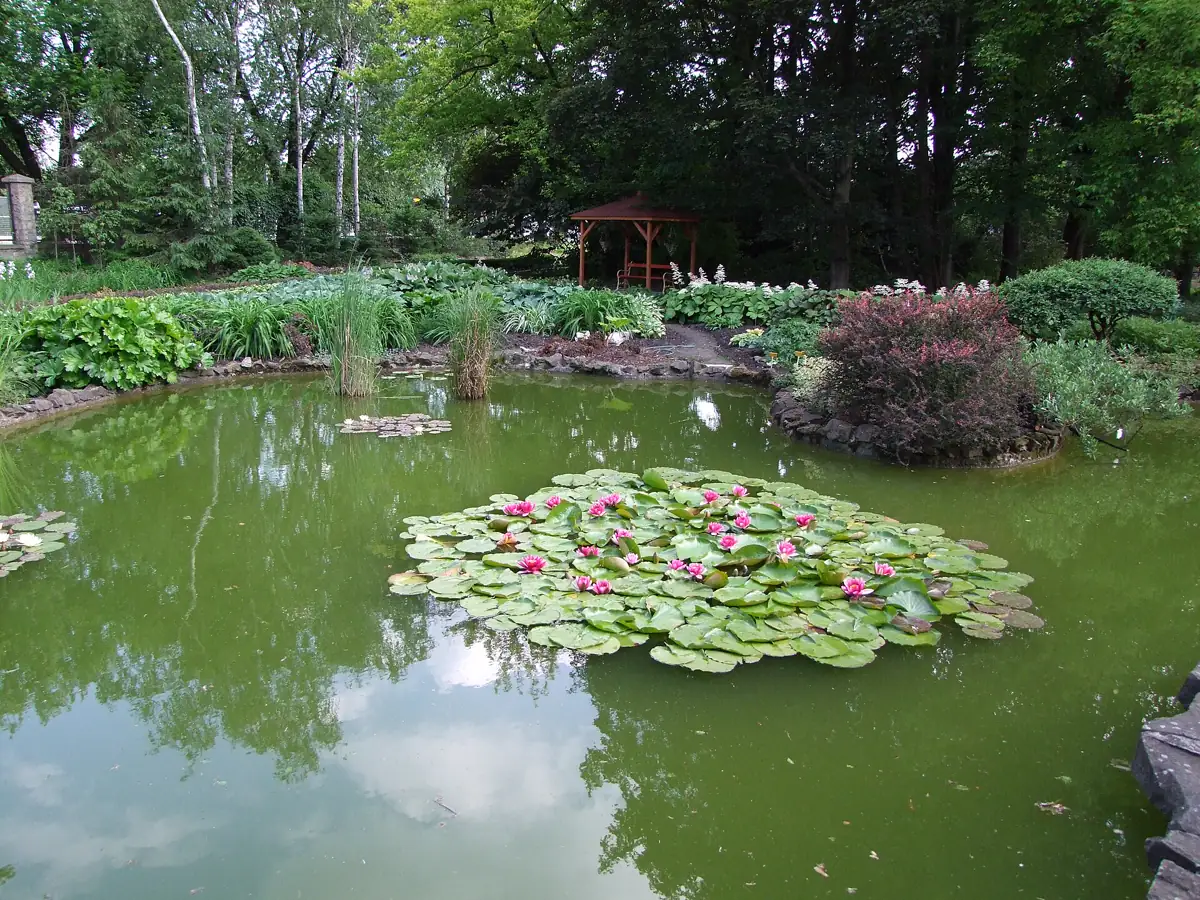
Alpine gardens imitate high-mountain conditions and help to preserve mountain plants. Water plants of the temperate zone, mostly native, grow in artificial ponds and pools.
The Victoria glasshouse has existed since the beginning of the garden, and it is named after the water plant that grows in its pool. The Jubilee glasshouse has a palm house and a long glasshouse divided into several sections. It opened in 1964 and is named after the 600th anniversary of the Jagiellonian University in that year.
The Warszewicz Orangery is also open on Mondays, unlike the other glasshouses. The small Holenderka (Dutch) glasshouse holds epiphytes, orchids and other rare plants that need protection from the public, and it is closed to visitors. The garden says that its whole collection has about 9000 plant taxa.
Museum of the Jagiellonian University Botanic Garden
The museum of the garden was set up and opened to visitors in 1983. Its collection has about 5000 objects, among them exotic fruits, seeds, wood, plant fossils and old teaching aids. An archive department collects material on the history of Polish botany, including material from the research of the classic Polish botanists.
The museum rooms have period-style furnishings. According to the Jagiellonian University, the museum is the oldest museum-type botanical collection in Poland, closely linked with the research and teaching of the university.
History of the garden: Jaśkiewicz, Warszewicz and Szafer
The garden was created on the initiative of the Commission of National Education (Komisja Edukacji Narodowej) as an auxiliary unit of the chair of chemistry and natural history. Its first professor of natural history and first director was Jan Jaśkiewicz (1749-1809). At first the garden was a Baroque park with a geometric layout of plants, and tropical plants grew in glasshouses built in 1786-1787.
In 1809 Alojzy Estreicher (1786-1852) became director, when the collection had more than four thousand species and varieties. The garden was enlarged in 1819-1825. The catalogue Catalogus plantarum of 1864 listed 9470 species and varieties, including 3779 glasshouse plants. In that decade the garden was among the gardens in Europe with the most plants.
Its inspector, or head gardener, was then Józef Warszewicz (1812-1866), a traveller and plant collector. He brought many thousands of plants from his expeditions to South and Central America. In 1878 Józef Rostafiński (1850-1928), a specialist in algae and slime moulds, became head of the chair of botany and the garden, and in 1882 a new palm house of iron and glass was built.
Marian Raciborski (1863-1917) led the garden in 1912-1917, and from 1918 Władysław Szafer (1886-1970) led it for 42 years. The present shape of the garden is the result of his work: new, modern glasshouses were built and new land was added. The garden is entered in the register of monuments as a valuable natural object and a monument of the history of science, garden art and culture.
Getting to Kopernika Street: stops, parking and garden rules
The nearest stops are Rondo Mogilskie for trams and Lubicz for buses. The garden has no car park of its own. You can leave a car on Kopernika Street, but because of the nearby hospitals it is hard to find a free space.
For your own safety, the garden asks you not to touch or pick the plants. Its rules also ban collecting seeds, walking outside the marked paths, entering during a storm or strong wind, and photography for commercial purposes.
Juliusz Słowacki Theatre and Florian Gate nearby
Distances below are measured in a straight line. The Juliusz Słowacki Theatre and the New Jewish Cemetery are each about 1100 m from the garden. The Grunwald Monument and the Florian Gate are each about 1200 m away.
Botanical Garden: questions visitors ask
Is the Botanical Garden in Krakow open on Mondays?
Yes. The garden and the ticket office are open every day, as listed in October 2026, but the museum and the glasshouses stay closed on Mondays, apart from the Warszewicz Orangery.
Can you bring a dog to the Botanical Garden?
No. Dogs are completely banned from the garden.
Where can I leave a bike at the Botanical Garden?
In the bike rack in the courtyard of Collegium Śniadeckiego, which is in front of the garden entrance. Bikes are not allowed in the garden itself.
Can you take a pram into the glasshouses?
No. Prams and other vehicles are not allowed in the glasshouses, as listed in October 2026.
Photo: Zygmunt Put, Wikimedia Commons, CC BY-SA 4.0, cropped.
Other places worth seeing

Ready to explore?
Book a tour, hop on an electric cart, or arrange a transfer.