St Anne's Church in Krakow: Masses and St John Cantius tomb
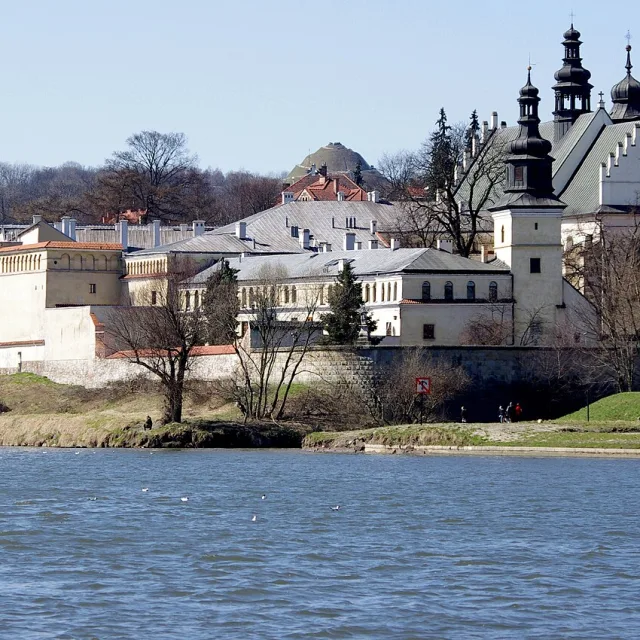
Built in 1689-1703 to a design by Tylman of Gameren, with a broad facade planned to be seen at an angle from a narrow street.
5 min walk from the Main Market SquareDirections
St Anne's Church in Krakow, on St Anne's Street near Collegium Maius, holds the tomb of St John Cantius and is the academic church of the Jagiellonian University. The Baroque Church of St Anne was built in 1689-1703 to a design by Tylman of Gameren, and Karol Wojtyła, later Pope John Paul II, often prayed here as a student. Masses are held according to the parish schedule, and the crypts beneath the church are closed to visitors.
- Address: Świętej Anny 11, 31-008 Krakow.
- Mass times: on Sundays and holidays the first Mass is at 7.30 and the last at 21.30 (as listed in October 2026).
- Getting there: VisitMałopolska lists paid parking.
Masses at St Anne's Church
As listed in October 2026, Masses on Sundays and holidays are at 7.30, 9.00, 10.00, 11.00, 12.00, 13.00, 19.30, 20.30 and 21.30. On other days they are at 7.00, 13.00 and 19.30, and on Thursdays the second of these Masses is held at the confessio of St John Cantius. On the first Friday of the month there is an additional Mass at 18:00.
Mass times change; check the current schedule on the parish website before your visit.
What to see at St Anne's Church
The broad, screen-like facade was planned to be seen at an angle, along the narrow street, the city authorities write. It has two storeys and two towers with late Baroque cupolas. Figures of St Casimir and St Florian stand in the upper niches, with St Bernard of Clairvaux and St John Cantius below them and the Eye of Providence at the top.
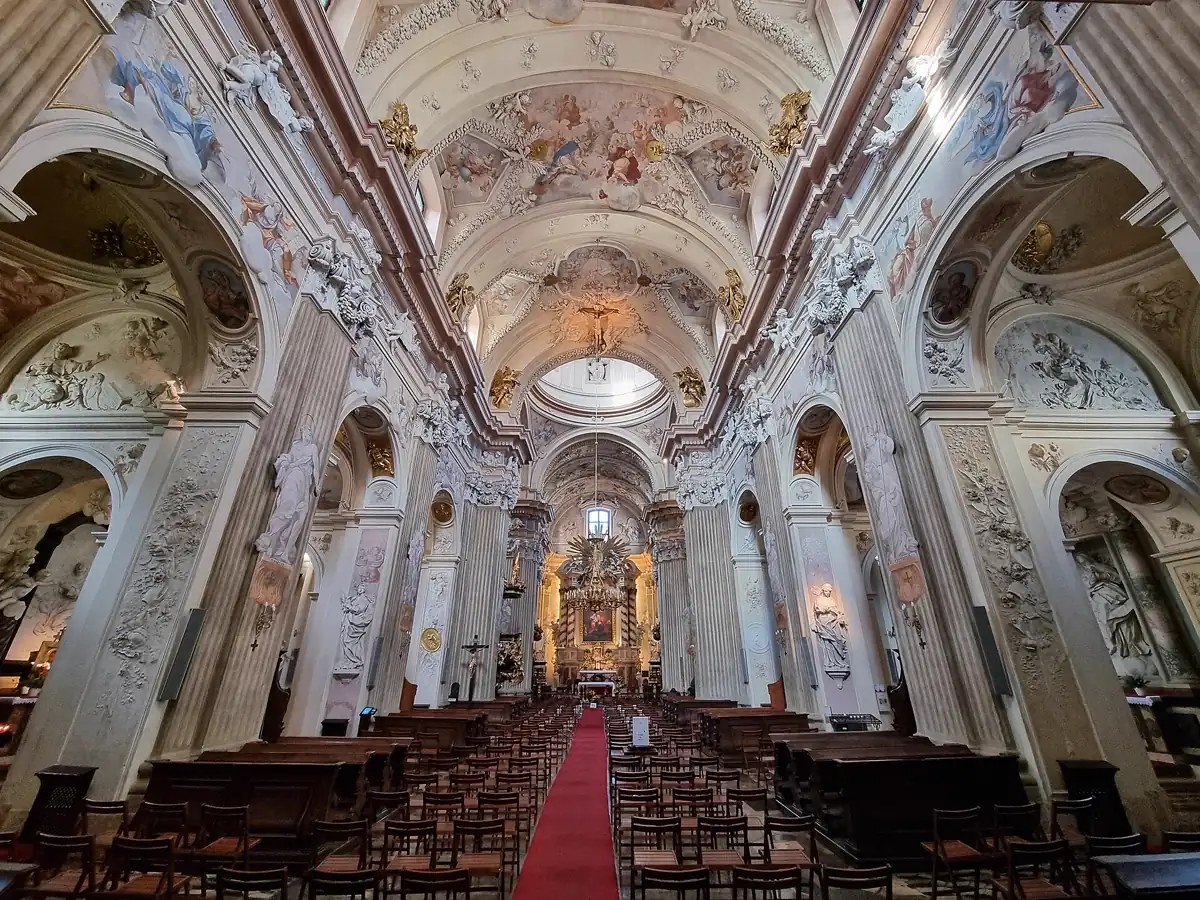
The church has the plan of a Latin cross, with a dome and lantern above the crossing of the nave and the transept (the cross-arm of the church). Three linked chapels line each side of the nave. Baldassarre Fontana, strongly influenced by Giovanni Lorenzo Bernini, made the sculptural decoration and the stucco. The wall paintings are by the brothers Karol and Innocenty Monti from Italy and by Karol Dankwart.
The dome rests on pendentives, the curved triangles of vaulting below it. The pendentives show the four cardinal virtues: Prudence, Temperance, Justice and Fortitude. The main altar, designed by Fontana, holds a painting of St Anne with the Virgin and Child by Jerzy Eleuter Siemiginowski, court painter of King Jan III Sobieski. According to the city authorities, natural light falls on the radiant gloria, a burst of rays, above the painting.
The decoration of the nave follows the Apocalypse of St John and, as the parish notes, shows a theme fairly rare in art: the Church as the heavenly Jerusalem. On the choir gallery is a late Baroque organ with 25 stops, built in 1723-1724 by Szymon Szadkowski. The parish describes it as the only organ in Krakow that keeps the authentic sound of the time of Johann Sebastian Bach.
The confessio of St John Cantius
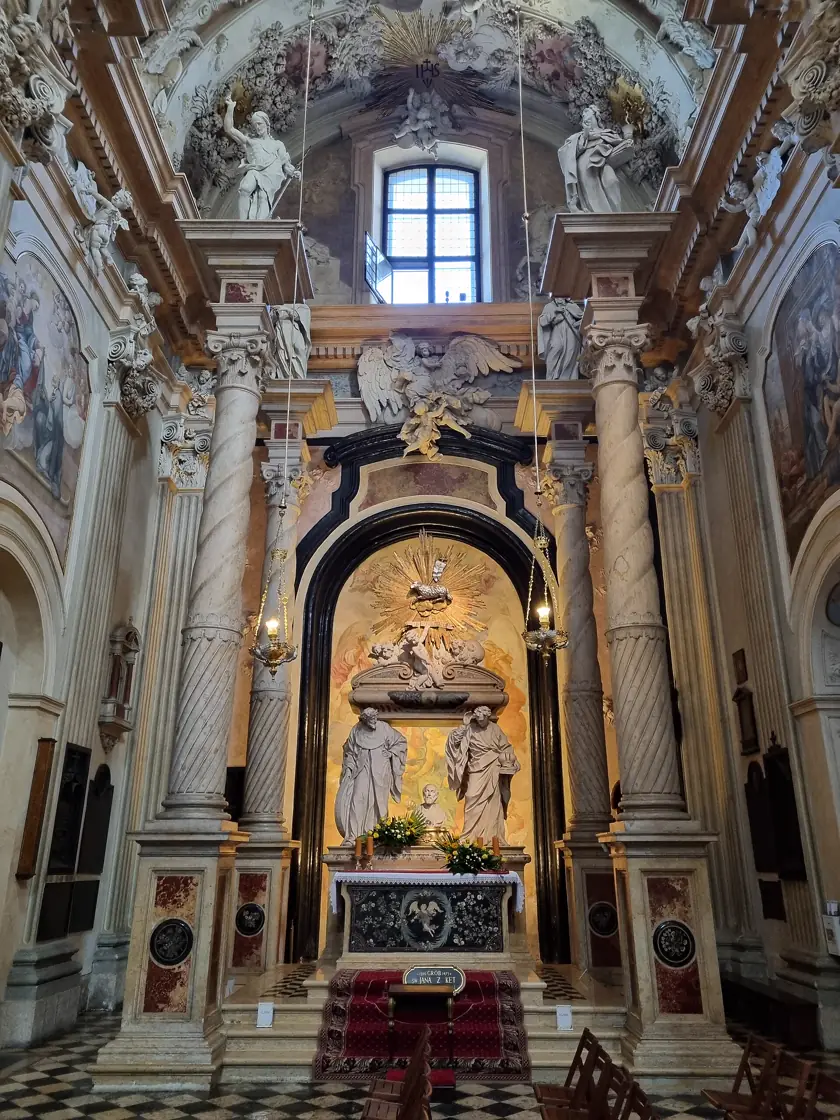
In the right arm of the transept stands the confessio of St John Cantius (1390-1473), whom the parish calls St John of Kęty. It is a monumental altar tomb made by Fontana in 1695-1703. Four figures carry his coffin on their shoulders. According to the city authorities, they stand for the faculties of the university in his time: Theology, Medicine, Philosophy and Law.
The confessio is clearly inspired by Bernini's confessio of St Peter in the Vatican, the parish writes. Its four twisted columns carry statues of four saints named John, and the parish calls them the largest monumental columns in Poland after the Zygmunt III Column in Warsaw. The city authorities say that Turkish horsetail standards captured at the Battle of Vienna in 1683 hang beside the confessio. These standards are military emblems made of horsehair.
Opposite the confessio is the Chapel of the Adoration of Christ Taken Down from the Cross. It holds a monument to Nicolaus Copernicus, funded in 1822 by Father Sebastian Sierakowski and made by Jan Nepomucen Galli, according to the parish. VisitMałopolska calls it Poland's first classicist statue of Copernicus.
History of the Church of St Anne
The oldest record of the church is a request of 27 September 1363 from King Kazimierz Wielki (Casimir the Great) to Pope Urban V. The present church is the third on the site, according to the city authorities. The first, made of wood, stood in the centre of the Jewish quarter of that time, next to a synagogue and a mikveh (a ritual bath). It burned down in 1407 during anti-Jewish riots, the city authorities write.
King Władysław Jagiełło funded a brick Gothic church in its place and placed it in the care of the Krakow Academy. In 1418 he gave the university the right of patronage, the right to propose the parish priest and to care for the church. On 27 October 1535 Bishop Piotr Tomicki raised it to the status of a collegiate church, a church with a chapter of canons.
St John Cantius was buried in the church in the 15th century, and in 1549 his remains were moved to a Renaissance tomb. The parish writes that the Gothic church was pulled down in 1689 because it was too small for his growing cult. University professors, supported by King Jan III Sobieski, a graduate of the university, decided to build a new, more imposing church. Father Sebastian Piskorski, parish priest and professor, was responsible for the work and planned the whole decoration.
The design came from the Dutch architect Tylman of Gameren (about 1632-1706), and the Italian architect Franciszek Solari also led the construction. The model was the Roman church of Sant'Andrea della Valle. As bishop, Karol Wojtyła celebrated Mass here, met students and heard confessions, according to VisitMałopolska, and as Pope John Paul II he visited the church in 1997.
Near the church: Collegium Novum and Krzysztofory Palace
Distances below are measured in a straight line. Pierogarnia Krakowiacy is about 50 m from St Anne's Church, and Collegium Maius is about 100 m away. Collegium Novum is about 150 m away, and Krzysztofory Palace about 200 m.
St Anne's Church: questions visitors ask
Is Juliusz Słowacki buried in St Anne's Church?
No. The church has an epitaph for Juliusz Słowacki, funded by his mother, but he is not buried there.
Can you visit the crypt of St Anne's Church?
No. Professors, canons and notable people were buried in the crypts, but the parish does not open them to visitors.
When does the carillon of St Anne's Church play?
Daily at 7, 9, 12, 15, 18 and 21, according to VisitMałopolska (as listed in October 2026). The carillon, a set of eight bells made in Milan, has played church hymns from the tower since 2006.
Photo: Bahnfrend, Wikimedia Commons, CC BY-SA 4.0, cropped.
Other places worth seeing
Ready to explore?
Book a tour, hop on an electric cart, or arrange a transfer.