Norbertine Convent in Salwator, Krakow: portal and relics
A convent founded in 1162 by the knight Jaksa Gryfita, where the relics of Blessed Bronisława rest in a gilded casket at her altar.
29 min walk from the Main Market SquareDirections
Krakow's Norbertine Convent in Salwator was founded in 1162 by the knight Jaksa Gryfita, and its church still has a Romanesque portal from the middle of the 13th century. The Norbertine Sisters' convent and the Church of St Augustine and St John the Baptist stand on an escarpment above the Vistula, at Kościuszki 88, in the area once called Zwierzyniec. The sisters live in enclosure, but VisitMałopolska, the tourist portal of the Małopolska region, describes the church as open.
Visiting the Norbertine Convent in Salwator
The Norbertines are an enclosed, contemplative order, and their living quarters are closed to tourists. According to VisitMałopolska, the church is open, and it is best visited before or after services. Some rooms of the convent are opened on selected days of the year. At the back of the church, the nave ends at the sisters' oratory, their own place of prayer, which the faithful cannot enter.
Current visiting arrangements and announcements are listed on the Norbertine Sisters' website.
Inside the Church of St Augustine and St John the Baptist
The Romanesque portal from the middle of the 13th century is in the porch on the north side, at the main entrance, below the tower. It was restored in 2020-2022. An early 16th-century crucifix, renewed in 2011, hangs in the same porch.
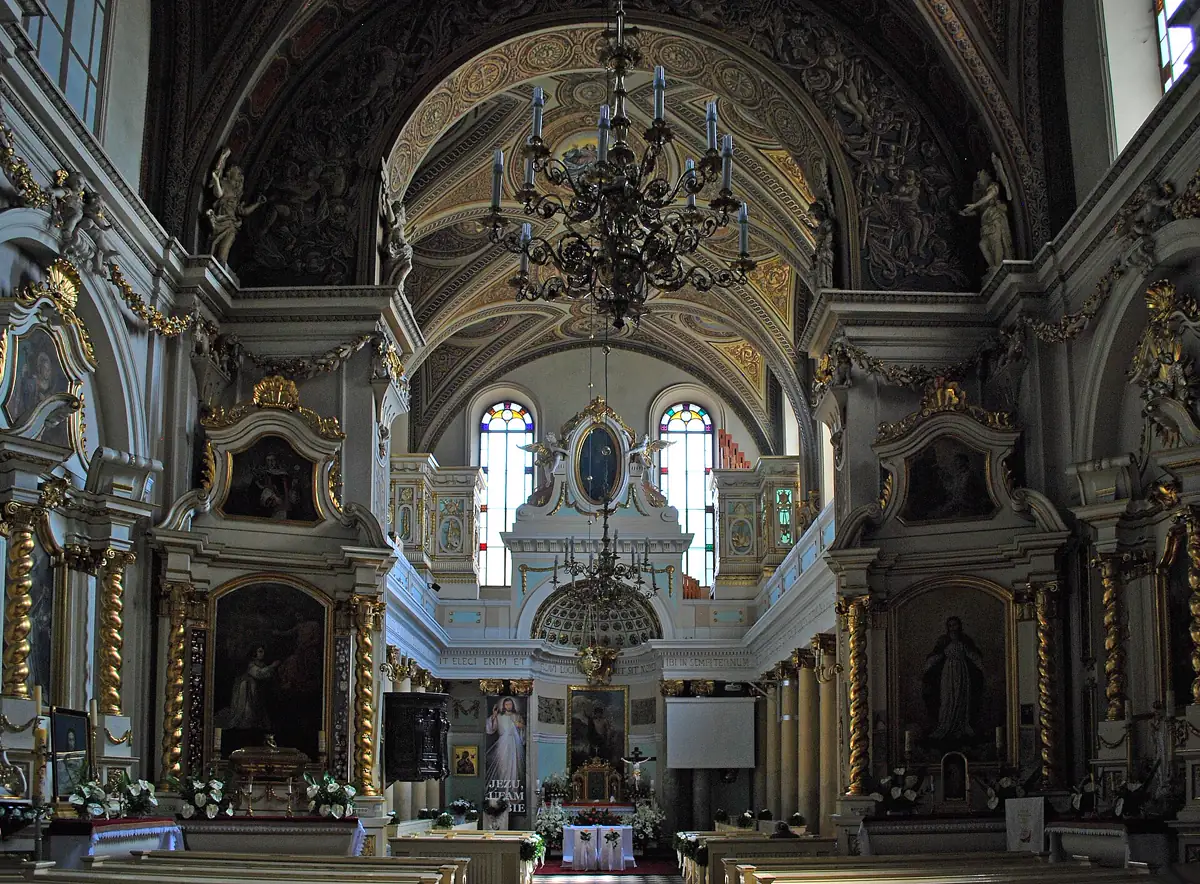
The church has a rectangular nave with a groin vault and a narrower classicist chancel, the part around the main altar. The painting on the vault shows Norbertine saints. A classicist colonnade from 1777 runs around the chancel, and oval medallions with Norbertine saints hang between its columns. In the apse of the main altar is an image of St John the Baptist by Władysław Łuszczkiewicz from 1876.
The pulpit from 1876 stands by the chancel arch, the arch between the nave and the chancel. On the left side of the church is a 17th-century marble font funded by Abbess Dorota Łukowska. An 18th-century Baroque figure of the founder, Jaksa Gryfita, stands on a pillar in front of the oratory. In the vestibule of the sacristy is a marble lavabo from 1696, a basin where the priest washes his hands.
Blessed Bronisława and her altar
Six Baroque altars from the 18th century stand in the nave. One of them is the altar of Blessed Bronisława, with her relics in a gilded casket. The casket stands on the altar with the painting Vision of Blessed Bronisława by Walery Eljasz-Radzikowski, from 1849.
According to the sisters, Bronisława, a great-granddaughter of Jaksa Gryfita, lived in the convent from 1220 to 1259 and helped to rebuild it after the Tatar raid. Pope Gregory XVI beatified her, that is, declared her Blessed, in 1839. The parish also cares for the neo-Gothic Chapel of Blessed Bronisława, built in 1856-1861 at the fort by Kościuszko Mound.
History of the convent from 1162
The parish writes that Jaksa Gryfita of Miechów founded the Romanesque convent in 1162 and brought monks and nuns of the rule of St Norbert; VisitMałopolska adds that he probably did so after returning from a crusade. The church was consecrated in 1181 by Bishop Gedko. The sisters write that the local chronicles burned a hundred years after the foundation, so the earliest history is reconstructed from legal documents.
VisitMałopolska counts the complex among the oldest in Krakow and among the largest historic complexes in the city, and calls the Norbertines the oldest female religious order in Poland. It dates the brick rebuilding of the church, again in the Romanesque style, to 1255-1259, after the Tatars had destroyed the convent in 1241. Fires followed in 1494 and 1527.
The sisters write that in 1587, when the army of Maximilian of Habsburg was approaching Krakow, Chancellor Jan Zamoyski ordered the suburbs to be burned for strategic reasons. On 29 October 1587 the whole of Zwierzyniec burned, with the convent and the chapel of St Margaret.
According to the parish, the present shape of the church comes from the time of Abbess Dorota Kątska, who began the rebuilding in 1596 to a design by Giovanni Battista Trevano, and Bishop Tomasz Oborski consecrated the enlarged church in 1638. VisitMałopolska names Giovanni Petrini as a second designer alongside Trevano. The sisters write that in 1613 Kątska built a new tower on the north side of the church, and that the whole Romanesque portal is now uncovered in the porch, in the lower part of this tower.
VisitMałopolska writes that in 1794 the convent stored weapons and cannons handed over to Tadeusz Kościuszko. The parish records that the church was fully renovated in 1976-2002, that Pope John Paul II stopped at the church on 19 August 2002 and blessed the parish, and Pope Benedict XVI stopped in the convent courtyard on 26 May 2006.
Near Salwator: Błonia Meadow and Jordan Park
Distances below are measured in a straight line. Błonia Meadow is about 850 m from the Norbertine Convent, and the Stained Glass Museum about 1050 m. The Main Building of the National Museum is about 1100 m away, and Jordan Park about 1150 m.
Norbertine Convent in Salwator: questions visitors ask
When is the novena to Blessed Bronisława at the Norbertine Convent?
Every Tuesday at 18:00, with a broadcast on YouTube. In a post from February 2025 (still listed in October 2026), the sisters describe it as prayer before her relics throughout the year.
Where exactly is the Romanesque portal of the Norbertine church?
In the porch under the tower, on the north side of the church, where visitors use the main entrance.
What happens at the Norbertine Convent on Easter Monday?
VisitMałopolska writes that on Easter Monday a church fair called Emmaus is held beside the convent.
Does the Lajkonik procession stop at the Norbertine Convent?
Yes. According to VisitMałopolska, the procession with the Lajkonik stops here in the octave of Corpus Christi. In that tradition the Lajkonik, also called the "konik zwierzyniecki" or the Tatar, is a bearded rider on a two-legged hobby horse, and the figure commemorates the Tatar raid of the 13th century.
Photo: Jakub Hałun, Wikimedia Commons, CC BY-SA 4.0, cropped.
Other places worth seeing
Ready to explore?
Book a tour, hop on an electric cart, or arrange a transfer.