Camaldolese Monastery in Bielany, Krakow: who may enter
A hermitage of white-robed monks on Srebrna Góra, behind a stone wall several kilometres long, where guests come to pray, not to sightsee.
Outside the city centreDirections
Krakow's Camaldolese Monastery in Bielany admits guests only under the strict rule of its hermit monks: men at set hours, women on 12 days a year. The Hermitage of the Camaldolese Fathers stands on Srebrna Góra, a hill that belongs to the area of Wolski Forest, at Aleja Konarowa 1. According to the city authorities, the monks let guests in to pray, not to sightsee.
- Address: Aleja Konarowa 1, 30-248 Krakow.
- Opening hours: for men, daily 10:00-11:00 and 15:30-16:30, according to the order (as listed in October 2026); for women, only on set days.
- Getting there: on foot by an asphalt road from Księcia Józefa Street, past the Srebrna Góra vineyard.
Who may enter the Camaldolese Monastery in Bielany
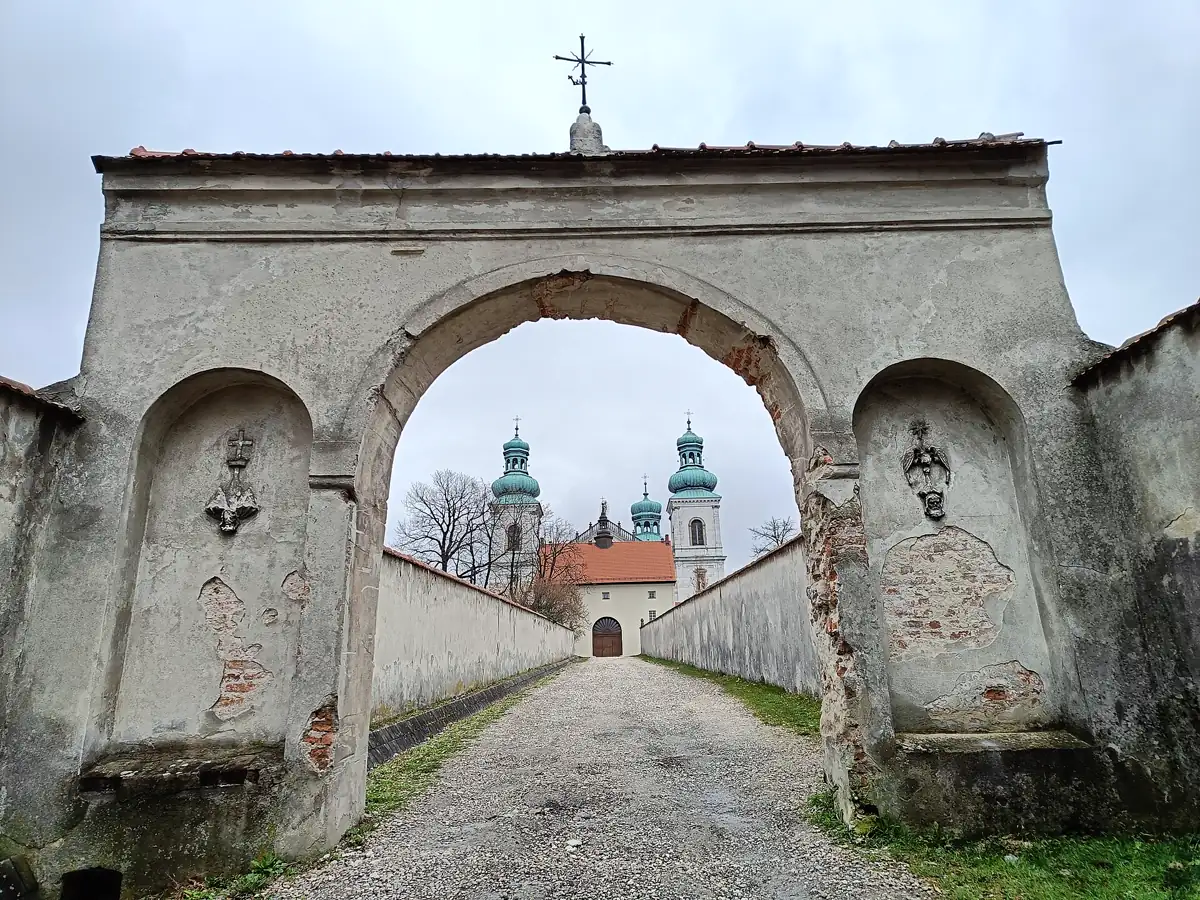
The whole hermitage is surrounded by a stone wall several kilometres long, which keeps the monks in strict enclosure. As listed by the order in October 2026, men may visit the hermitage daily from 10:00 to 11:00 and from 15:30 to 16:30. The city tourist portal krakow.travel gives different hours, so check the current times with the order before your visit.
Under the bull Splendor paternae gloriae, issued by Pope Paul V on 19 February 1610, women may visit the Hermitage of Srebrna Góra only on set days. The order lists them as 7 February, the Annunciation (on the day it falls that year), Easter Sunday, Pentecost Sunday and the Monday after it, and Corpus Christi. The list continues with 19 June and the Sunday after that date, 15 August (the Assumption), 8 September, 8 December and Christmas Day.
Current announcements are listed on the Camaldolese order's website.
The Church of the Assumption of the Blessed Virgin Mary
The city authorities write that the two-tower stone facade is much wider than the body of the church and was designed to be seen from a distance. According to the National Institute of Cultural Heritage, it is 41 metres wide and, with the towers, 48 metres high. It is made of limestone blocks, decorated with black Dębnik marble and figures of saints, and a statue of the Virgin Mary, the patron of the church, stands at the top.
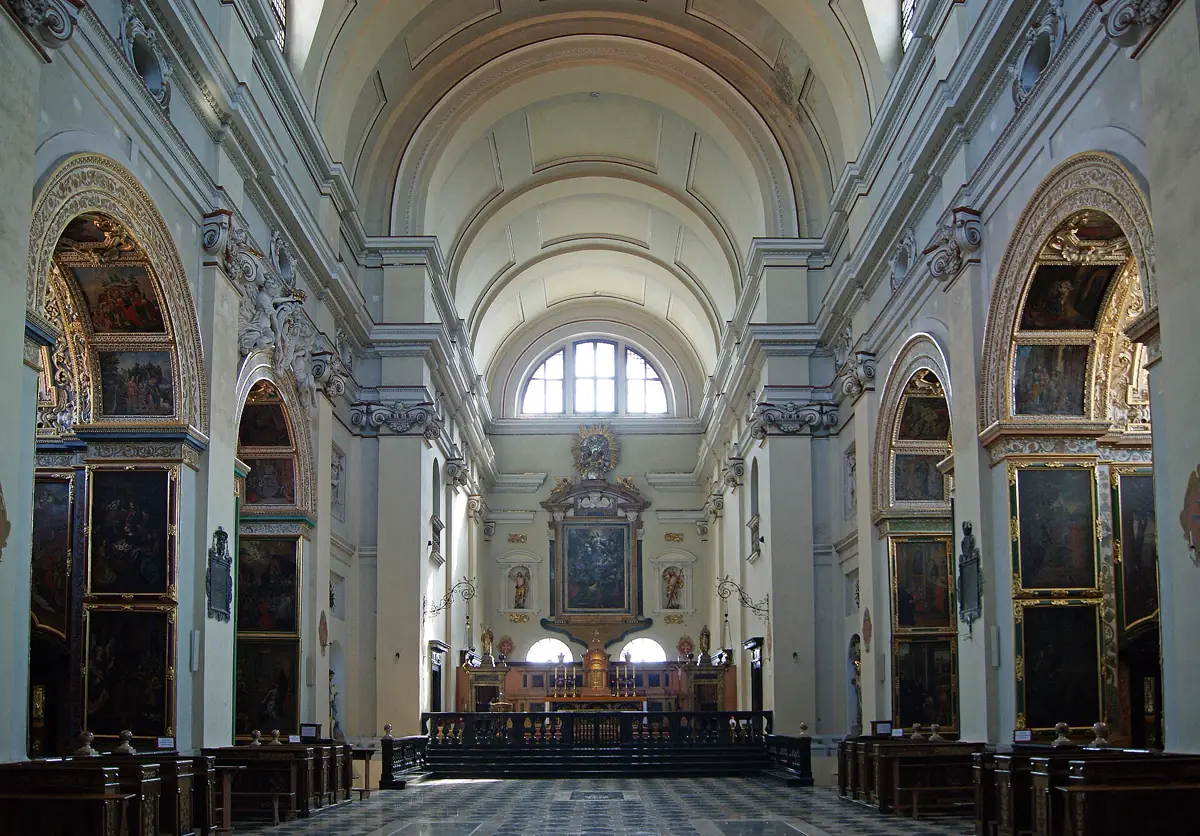
The single nave is more than twenty metres high and has a barrel vault. Its plain walls contrast with the very rich decoration of the chapels: stucco, wall paintings, paintings, sculptures and gilding. On the left of the entrance are the chapels of the Annunciation, St John the Baptist, and St Benedict and St Ladislaus, called the Royal Chapel. On the right are the chapels of St Michael the Archangel, St Peter and St Romuald.
Each tower holds a chapel: the Lubomirski Chapel in the south tower and the Czartoryski Chapel in the north tower. The city authorities single out the stucco of these chapels from the workshop of Jan Baptysta Falconi (1642) and their altars designed by Francesco Placidi (1759-1763). The Royal Chapel and the Chapel of St Romuald have paintings by Tomasz Dolabella, a royal painter. The order says that the image of Matka Boża Kamedulska (Our Lady of the Camaldolese) is known for graces. Father Wenanty of Subiaco, a Camaldolese monk, painted it in the 17th century.
Life of the hermits on Srebrna Góra
The centre of each monk's life is his own small hermitage house. The monks meet only for Mass, for the Liturgy of the Hours and, on special occasions, for meals in the refectory, the monastery dining room. They eat alone, and they may not visit one another. During prayers in the church they use no organ or other musical instrument.
According to the city authorities, the monks keep silence at all times and speak only when necessary, away from others and in low voices. Only on Tuesdays, Thursdays and Saturdays may they have a short conversation. They give up meat, and in Lent also dairy products and eggs. The monastery has no radio or television, and five times a year all the monks may leave the hermitage together for an outing.
The order describes its congregation, the Camaldolese Hermits of Monte Corona, as having only 9 monasteries in the world, with about 60 monks. Krakow.travel calls the Bielany house one of only two active Camaldolese monasteries in Poland.
History of the Bielany hermitage
The Camaldolese came to Krakow early in the 17th century at the invitation of Mikołaj Wolski, Grand Marshal of the Crown. The National Institute of Cultural Heritage dates the foundation of the hermitage and the start of the building work to 1604. In 1605 Bernard Maciejowski, Bishop of Krakow, laid the foundation stone for twenty monks' houses, and building of the church began in 1610.
The Italian architect Andrea Spezza worked on the building. According to the National Institute of Cultural Heritage, the church is one of the largest artistic foundations of the early Baroque in Poland. More than 200 artists and craftsmen are estimated to have worked on it around 1610. The order writes that Wolski spent the last part of his life in the monastery and was buried there in a Camaldolese habit.
Krakow.travel lists royal visitors including Ladislaus IV Vasa, John Casimir during the Swedish invasion known as the Deluge, and John III Sobieski before he went to relieve Vienna. According to the National Institute of Cultural Heritage, the monastery suffered its greatest losses at the beginning of the 18th century, when Russians plundered it. A fire in 1814 destroyed the cupola of the bell tower, and a new cupola was made only in 1887.
In 2002, at the end of his pilgrimage to Poland, John Paul II came to Srebrna Góra and, the order records, promised to pray for vocations. The order also writes that as Cardinal Karol Wojtyła he had called the Camaldolese the lightning conductor of Krakow, while krakow.travel attributes the remark to that visit of 2002.
Near Srebrna Góra: Piłsudski's Mound and Tyniec
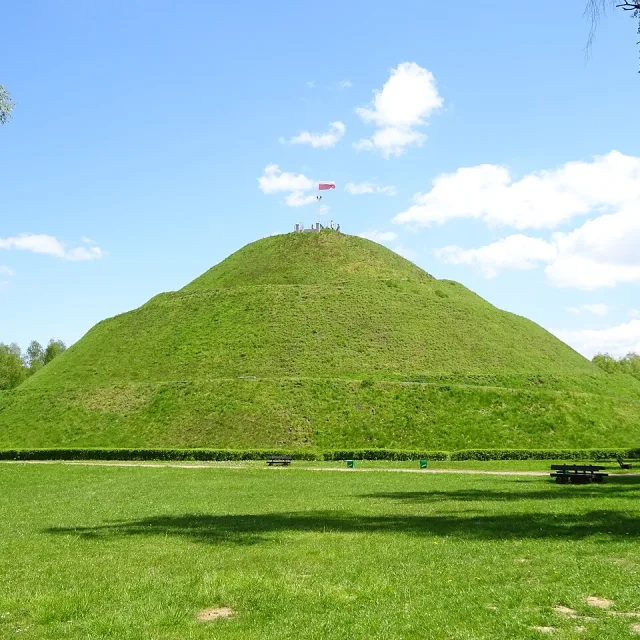
A city walking route starts at the western edge of Wolski Forest, on Księcia Józefa Street, and climbs to the summit by an asphalt road past the Srebrna Góra vineyard. From the hill, the route continues through the Polana pod Dębiną meadow towards Piłsudski's Mound, which is about 1650 m away in a straight line. Kościuszko Mound is about 3900 m away, and Tyniec Benedictine Abbey about 4050 m.
Camaldolese Monastery in Bielany: questions visitors ask
Can you attend midnight Mass at the Camaldolese Monastery in Bielany?
No. By decision of the congregation's superiors, the faithful may not attend the Christmas midnight Mass or the Easter morning Mass of the Resurrection celebrated in the hermitage.
Why is the district called Bielany?
The city authorities say the name comes from the white habits of the monks. The white Camaldolese habit consists of a tunic, a scapular with a hood, a belt and a wide cloak.
Why is the hill called Srebrna Góra?
Tradition has it that the owner of the hills, Sebastian Lubomirski, did not want to give them up. In the city's version, Wolski won him over with the silver dishes used at a feast; the order tells it as a gift of thanks once Lubomirski had agreed. Either way, the hill has been called Srebrna Góra, Silver Mountain, ever since.
Photo: Jerzy Opioła, Wikimedia Commons, CC BY-SA 4.0, cropped.
Other places worth seeing
Ready to explore?
Book a tour, hop on an electric cart, or arrange a transfer.