Piłsudski's Mound in Krakow: the climb, the view and history
A mound raised by volunteers in 1934-1937 from earth brought from battlefields where Poles fought, and rebuilt after decades of neglect.
Outside the city centreDirections
Piłsudski's Mound in Krakow stands on Sowiniec hill in Wolski Forest, and the city authorities describe it as the largest of Krakow's mounds, 35 m high. Volunteers raised it in 1934-1937 in honour of Marshal Józef Piłsudski and the fight for independence; it is also called Kopiec Niepodległości, the Independence Mound.
Climbing Piłsudski's Mound: the view and the urns
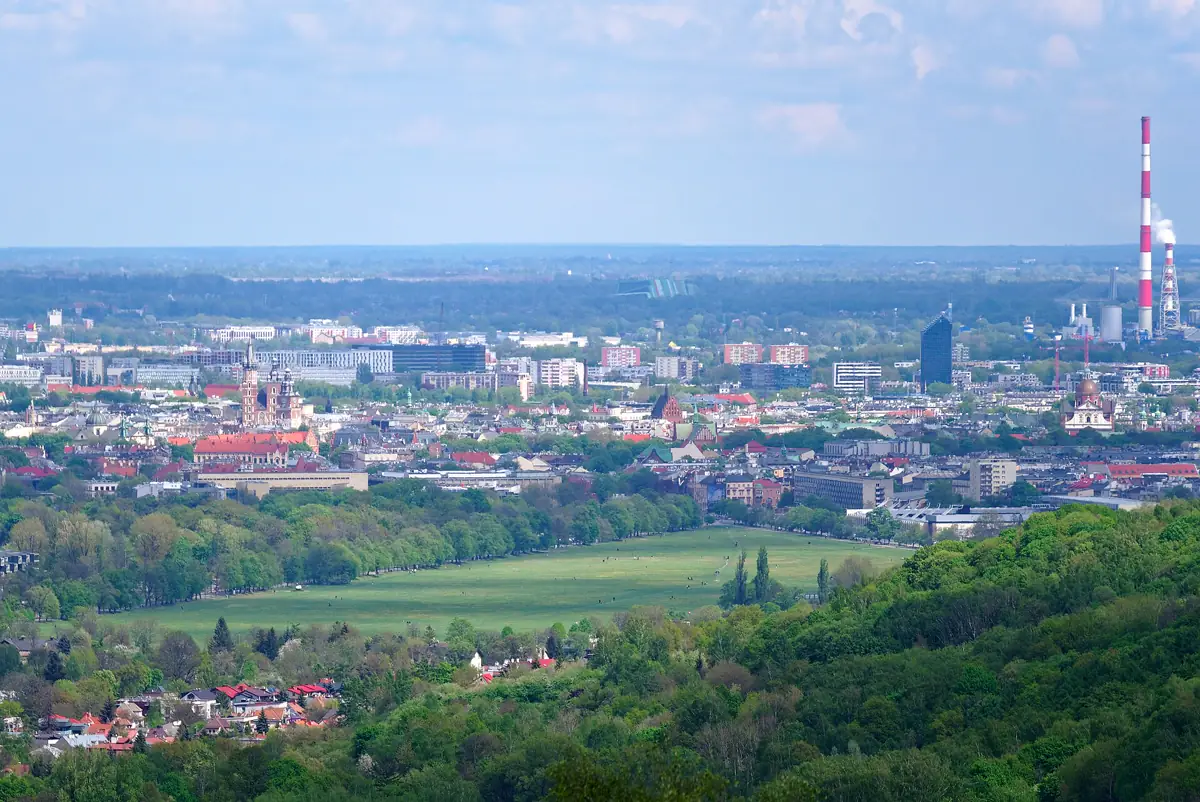
The city authorities write that the effort of the climb is rewarded by a view of Krakow and its western surroundings, with Krakow Airport and the reservoir at Kryspinów. According to the Polish Press Agency (PAP), the platform on the summit was replaced after landslides on large parts of the mound in 2010. A faithful replica of the granite slab with the Legion Cross was unveiled in 1991, on the day before Independence Day (11 November).
At the foot of the mound are urns with earth from battlefields where Poles fought. In 2017 Jerzy Bukowski of the committee that cares for the mound said that new earth from places where Poles fought and died was still being laid on it. The mound was built with 130,000 cubic metres of earth and is one of the five mounds in Krakow.
How to get to Piłsudski's Mound
According to the city authorities, the easiest way up starts at the main gate of the Krakow Zoo, where there is a public transport stop, while experienced walkers can climb from Bielany, starting on Księcia Józefa Street, or from Wola Justowska, starting on Kasztanowa Avenue. The mound is also the first point of the city walking route Korona szczytów Krakowa (Crown of Krakow's Peaks).
The City of Krakow describes the mound on its official website.
History of the mound from 1934 to 1937
The Union of Polish Legionnaires took the building of the mound under its patronage. In March 1934 the architect Prof. Adolf Szyszko-Bohusz proposed Sowiniec, the highest hill in Krakow, as the site, and the design chosen was by the engineer Franciszek Mączyński. Work began on 6 August 1934, the 20th anniversary of the march of the First Cadre Company of the Legions from the Oleandry in Krakow.
Building started during the Marshal's lifetime, and after his death on 12 May 1935 the work went faster. Volunteers built the mound, carrying most of the material in wheelbarrows, and people across Poland collected money for it. Relays of volunteers on foot, by water and by car brought earth from battlefields where Poles fought. The work ended on 9 July 1937, and a flag mast and the granite slab with the Legion Cross were placed on the summit.
The mound under German occupation and communist rule
On 26 October 1939 Krakow became the capital of the General Government and the seat of the German occupation authorities. In spring 1941 the German governor Hans Frank ordered the removal of Piłsudski's Mound and Kościuszko Mound, but the order was not carried out.
After the war the communist authorities removed the name of the mound from guidebooks and from the city plan. In 1953 the slab with the Legion Cross was taken off the summit, and a PAP text published by Radio Kraków says that a tank was used. Trees were planted on the slopes. Their roots damaged the structure of the mound. The city authorities write that the communist authorities deliberately allowed the mound to be ruined.
On 23 June 1980 a Committee for the Care of Józef Piłsudski's Mound was formed, and a year later the mound was entered in the register of monuments. The committee's chairman recalled that for the first 10 years the rebuilding was voluntary work. After heavy rain in 1996 and 1997, 65 percent of the slopes slid, and the repairs took five years. In 2012 the mound regained its pre-war appearance.
Near the mound: Camaldolese Monastery and Kościuszko Mound
Distances below are measured in a straight line. The Camaldolese Monastery in Bielany is about 1650 m from Piłsudski's Mound. Kościuszko Mound is about 3350 m away, and Błonia Meadow about 4600 m.
Piłsudski's Mound: questions visitors ask
How big is Piłsudski's Mound?
It is 35 m high and 111 m across at the base. PAP calls it the largest mound in Poland, with Kościuszko Mound less than a metre lower.
Is Piłsudski's Mound the same as Kościuszko Mound?
No. Kościuszko Mound was raised in 1820-1823, and it stands about 3350 m away in a straight line.
Why is Piłsudski's Mound called the Grave of Graves?
Dr Jerzy Bukowski, chairman of the committee that cares for the mound, calls it the "Mogiła Mogił" (Grave of Graves) because it holds earth from more than 4.5 thousand battlefields and places of martyrdom of the Polish nation around the world.
Photo: Mach240390, Wikimedia Commons, CC BY 3.0, cropped.
Other places worth seeing

Ready to explore?
Book a tour, hop on an electric cart, or arrange a transfer.