Lord's Ark Church in Krakow: Mass times and the cross-mast
A church built by hand in 1967-1977 in Nowa Huta, a town where, according to the parish, there was to be no place for a new church.
Outside the city centreDirections
Lord's Ark Church in Krakow (Arka Pana) stands under a steel cross-mast in Bieńczyce, Nowa Huta. Cardinal Karol Wojtyła, later Pope John Paul II, consecrated it on 15 May 1977 after ten years of building. Its official name is the Church of Our Lady Queen of Poland, and the city calls it the Ark of the Lord because of its shape. Masses are held according to the parish schedule, and the parish describes the church as a Fatima sanctuary.
Mass times at Lord's Ark Church
As listed in October 2026, Masses on Sundays and solemnities are at 6:30, 8:00, 9:30, 11:00, 12:30 (with baptisms), 16:00, 17:30 and 19:00. On days other than Sundays and holidays they are at 6:00, 6:30 (not in Advent), 7:00, 7:30 (not on Wednesdays or first Fridays), 8:00 and 11:00 (both in the Fatima grotto), and 18:00.
Confession is heard in the Chapel of Reconciliation, and on Sundays and holidays it starts a quarter of an hour before each Mass. From May to October, Fatima services are held on the 13th of each month at 18:00. The parish celebrates its patronal feasts on 3 May and on 13 September, when it honours Our Lady of Fatima.
Mass times change; check the current schedule on the parish website before your visit. Publications about the church are sold in the souvenir shop next to the church, by the field altar.
What to see at Lord's Ark Church
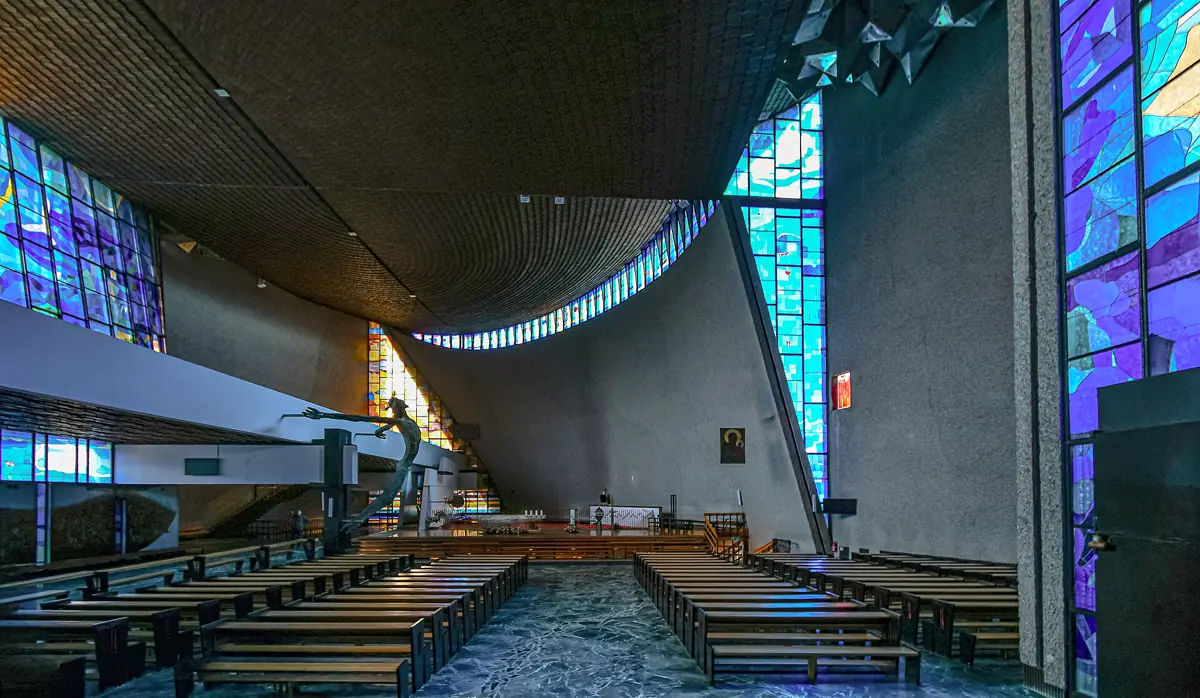
A steel cross-mast 68 m tall, anchored 14 m below the ground, rises above the church and is the main element of its structure. A gilded steel crown at the top points to the Marian character of the church. The four reinforced concrete walls are 30 m high and 30 cm thick, and the architect intended them to represent four sails. Outside they are faced with pebbles from Polish rivers.
The roof has the shape of a wide boat with high sides covered in larch shingles. Inside, its underside forms the ceiling, divided into four planes, and the gaps between them make a lit cross. The floor slopes slightly towards the altar and is laid with green, white-veined marble from a quarry at the foot of Mont Blanc. The floor is meant to symbolise the waters of the Flood.
The altar is a block of white marble with green veins, shaped like a flat, outstretched hand, and it holds relics of St Stanislaus. The bronze tabernacle has the shape of a sphere that recalls the Earth seen from space or the surface of the Moon. On the left side of the nave hangs a 7.8 m bronze figure of Christ, From Life to Life, by Bronisław Chromy, from 1977.
To the right of the altar, an image of Our Lady Queen of Poland, a faithful copy of the painting in the Bernardine church in Zbaraż, hangs on two steel cables. Below the roof, above the mezzanine (an upper gallery inside the nave), hangs a cross-anchor. It holds a bronze cross, the remains of the damaged cross that people defended in 1960. That damaged cross was replaced with a new one on 1 May 1972. The organ, built by Rudolf von Beckerath Orgelbau of Hamburg, has 46 stops and 3356 pipes.
The Chapel of Reconciliation and the Fatima grotto
The Chapel of Reconciliation lies below the church, and you enter it from the pavement on Obrońców Krzyża Street or from the sacristy. It was the first place of worship opened to the faithful during the building work, in December 1973. A sandstone wall in the chapel refers to the "death wall" at Auschwitz, the former German Nazi camp. The chapel also holds the sculpture of St Maximilian Maria Kolbe, Umęczony Człowiek, by Antoni Rząsa.
The Chapel of Our Lady of Fatima, called the Grotto, is to the right of the main entrance, "under the bells". It holds the statue of Our Lady of Fatima, crowned with a papal crown on 13 September 1992, and a reliquary of Saints Jacinta and Francisco and of St John Paul II.
History of the Ark of the Lord in Nowa Huta
According to the parish, the planners of Nowa Huta were told that there was no place in the town for a new church, because it was to be socialist, that is, without God. The first faithful prayed in a small chapel at a children's shelter run by the Servant Sisters of Dębica; Father Karol Wojtyła preached in that chapel as early as 1950. The parish in Bieńczyce was established in 1952.
In November 1956 the parish received permission to build a church on another site, on the Teatralne estate. On 10 June 1959 the communist authorities withdrew it, took the money and building materials, and began to build a school there. On 27 April 1960 workers with a bulldozer came to remove the cross standing on the site, which started the defence of the cross in Nowa Huta. The city describes building the Ark as the response to the withdrawn permission.
In October 1965 the parish received a new site for the church, on the site of its existing chapel. The church was planned as a votive offering for the millennium of the baptism of Poland, with Mary Queen of Poland as its patron. On 14 October 1967 Cardinal Karol Wojtyła dug the first clods of earth for it.
The parish writes that the church was built by hand, like medieval churches, with shovels, picks, barrows and peasant wagons, and explains the long building time: the communist authorities approved the design piece by piece, and building materials were rationed. During that time Cardinal Wojtyła often said Mass in the open air, especially the midnight Mass of Christmas Eve. Nowa Huta, the city notes, received its own church almost 30 years after the building of the town began.
Martial law and the Bogdan Włosik monument
The city authorities write that under martial law Masses for the Homeland were held in the Ark on the 13th of each month, and that after them people demonstrated against the authorities' violations of civil rights, the internment of Solidarity activists and repression. The authorities of the Polish People's Republic usually broke up these demonstrations by force.
A monument opposite the church marks the place where an officer of the Security Service (SB) shot dead Bogdan Włosik in 1982. He was a 19-year-old pupil who worked at the Lenin Steelworks.
Near the church: Avenue of Roses and Central Square
Distances below are measured in a straight line. The Avenue of Roses is about 1200 m from Lord's Ark Church, and Bar Mleczny Centralny about 1400 m. Central Square (Plac Centralny) is about 1550 m away, and the Nowa Huta Reservoir about 1800 m.
Lord's Ark Church: questions visitors ask
Why is it called the Lord's Ark?
The city says the name comes from its shape. The parish adds that the investor and the architect wanted the building to look like a large boat, like Noah's Ark.
Who designed Lord's Ark Church?
The architect Wojciech Pietrzyk. The city writes that he was inspired by Le Corbusier's chapel at Ronchamp, and the parish names Prof. Jan Grabacki as the structural engineer.
Is there a stone from the Moon in Lord's Ark Church?
Yes. According to the parish, the tabernacle holds a Moon stone that Pope Paul VI received from the Apollo 11 crew and gave to Cardinal Karol Wojtyła, who gave it to the church.
When do the bells of Lord's Ark Church ring?
Every full hour from 6:00 to 21:00 (as listed in October 2026). The eight bells in front of the entrance were a gift from Dutch Catholics and form a small carillon.
Photo: Mach240390, Wikimedia Commons, CC BY 4.0, cropped.
Other places worth seeing
Ready to explore?
Book a tour, hop on an electric cart, or arrange a transfer.