St Andrew's Church in Krakow: Mass times, Romanesque towers
A fortified Romanesque church with two octagonal towers, given to the Poor Clares in the 14th century; the sisters still live in the convent next to it.
9 min walk from the Main Market SquareDirections
St Andrew's Church in Krakow (Kościół św. Andrzeja Apostoła) has stood on Grodzka Street since the end of the 11th century, about 50 m in a straight line from the Church of Saints Peter and Paul. It is the church of the Poor Clares, a community of sisters who still live in the convent next to it. The Archdiocese of Krakow lists Masses here on Sundays and on other days.
- Address: Grodzka Street, Krakow.
- Mass times: on Sundays and holidays at 7:00 and 10:00 (as listed in October 2026).
- Accessibility: a tactile model with Braille descriptions stands on Grodzka Street.
St Andrew's Church Mass times
On days other than Sundays and holidays, Mass is at 7:00. On Sundays and holidays there is also a Mass at 10:00. According to the Archdiocese of Krakow, the times are the same in summer and in winter (as listed in October 2026). These are times of services, not visiting hours.
The Archdiocese of Krakow and one page of the city authorities give the address as Grodzka 54; another city page gives No. 56. The Poor Clares do not admit outsiders beyond the enclosure, the closed part of the convent. Times can change; check the current details on the Archdiocese of Krakow website before your visit.
What to see at St Andrew's Church
The building is made of stone and has three aisles, with two towers on the west side and a brick Gothic oratory added later. The oratory dates from the time of the handover to the Poor Clares, and today it is the sacristy. Both towers are octagonal and have small windows of a distinctive shape. Their Baroque caps contrast with the plain Romanesque façade.
The lower parts of the walls have no windows, and there are narrow slits for shooting, which show that the building once had a defensive role. A Romanesque window divided by two columns decorates the upper part of the façade on Grodzka Street. VisitMałopolska, the regional tourist portal that describes the church in most detail, calls it a triforium, a three-part Romanesque window, added during the rebuilding at the turn of the 12th and 13th centuries.
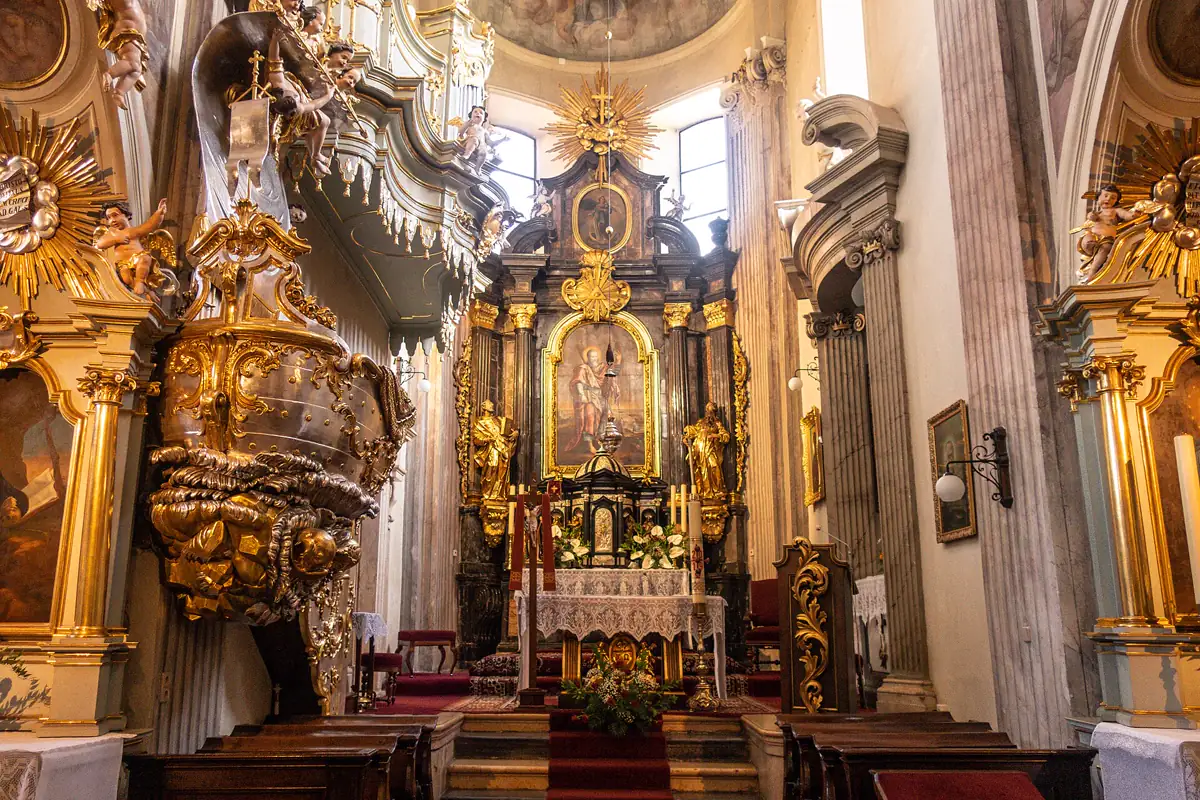
The Baroque interior, with rich stucco decoration that VisitMałopolska attributes to Baldassarre Fontana, dates from a rebuilding around 1700. The boat-shaped pulpit, the choir loft and the Rococo organ stand out inside.
The pulpit is wooden and partly gilded and comes from the same period as the organ, whose Rococo ornament dates it to the late 18th century. The Cistercian organ builder Sitarski and his assistants made the organ for the Poor Clares. The openwork wooden balustrades of the gallery, with medallions and plant motifs, date from 1700.
In 1726 a floor of Dębnik marble laid in a diamond pattern was funded, together with a portal from the chancel to the sacristy built to a design by Andrea Pozzo. The side altars of the Immaculate Conception, St Francis and St Clare were made at the end of the 18th century.
On Grodzka Street, a tactile model with Braille descriptions shows the churches of Saints Peter and Paul and St Andrew with the convent buildings of the Poor Clares. A second model, of a Romanesque biforium, a window divided in two, hangs on the low wall around the entrance from Grodzka Street.
The lower castle: defence and the Tatar raid of 1241
The church was even called the lower castle, as opposed to the upper castle, Wawel Royal Castle, which stands nearby. According to the city authorities, it belonged to Okół, the settlement below the castle on Wawel. VisitMałopolska writes that the church then stood outside Krakow, in Okół, which stretched from Poselska Street to Wawel.
The church had a strictly defensive role: it was fortified and surrounded by a rampart and a moat. The church, enlarged and strengthened, held out against a Tatar raid in the middle of the 13th century and gave shelter to the people of the town. The city authorities name the Tatar raid of 1241 as an example of such shelter.
The residents took shelter in the church and defended the settlement, in the account of Jan Długosz quoted by VisitMałopolska. Długosz wrote that the church was the only building to survive the fighting without any damage.
History of St Andrew's Church and the Poor Clares
The stone church was built at the end of the 11th century; VisitMałopolska, whose account the dates in this section follow unless the city authorities are named, gives the years 1079-1098. The city authorities call it the best-preserved Romanesque building in Krakow and one of the oldest buildings in the city. The church was first dedicated to St Giles. In 1101 Bishop Lambert of Krakow established a collegiate chapter at the church, and the dedication to St Andrew appeared for the first time.
The first church had one nave and a long chancel ending in a semicircular apse. It was rebuilt into a basilica with three aisles at the turn of the 12th and 13th centuries; the city authorities date this rebuilding to the beginning of the 13th century.
In the 14th century the church was given to the Poor Clares, and the collegiate chapter moved to the nearby Church of St Giles. A convent was built for the sisters on the south side of the church: King Władysław Łokietek funded it, it was built around 1325, and it was extended in the 17th and 19th centuries.
In the 15th century fires destroyed the church twice, in 1455 and 1473. After the fire of 1455, new convent buildings were built at the expense of Jan Długosz.
In the 17th century the towers received Baroque caps. In 1639 the towers were raised and the windows of the nave were enlarged to give more light, as part of a rebuilding that lasted from 1638 to 1707 under the supervision of Father Sebastian Piskorski.
In 1844, when Grodzka Street was widened, the part of the church added on the west was demolished in spite of strong protests from the sisters. In the same year the convent façade on Grodzka Street received neo-Romanesque forms to match the church.
The church is entered in the register of monuments.
Around the church: Kanonicza Street and Wawel Cathedral
Distances below are measured in a straight line. Kanonicza Street is about 100 m from St Andrew's Church, and the Pod Temidą milk bar is about 150 m away. Wawel Cathedral is about 300 m away.
St Andrew's Church: questions visitors ask
Where is St Andrew's Church in Krakow?
On Grodzka Street, next to the Church of Saints Peter and Paul and about 100 m from Kanonicza Street.
Can you visit the convent at St Andrew's Church?
No. The Poor Clares live in the convent and do not let outsiders into the enclosure.
How old is St Andrew's Church?
It was built at the end of the 11th century. VisitMałopolska dates the construction to 1079-1098.
Photo: Jeremiah Z. Cockroach, Wikimedia Commons, CC BY-SA 4.0, cropped.
Other places worth seeing
Ready to explore?
Book a tour, hop on an electric cart, or arrange a transfer.