Heroes of the Ghetto Square in Krakow: the chairs memorial
The former plac Zgody in Podgórze, where the Germans assembled Jews of the Krakow ghetto before deportation. Today 33 chair-monuments and 37 ordinary chairs stand on the square, beside the Eagle Pharmacy museum.
Heroes of the Ghetto Square (plac Bohaterów Getta) is a square in Podgórze that lay inside the ghetto set up by the German occupation authorities in 1941. It was then called plac Zgody, and it was the place where the Germans assembled Jews before deportation. Today a memorial made of chairs stands on it.
History of Ghetto Heroes Square
The square is a place of remembrance of the Holocaust. It was formerly called Mały Rynek and later plac Zgody. As the city records, plac Zgody (today's Heroes of the Ghetto Square) was the place where the Germans assembled Jews and then sent them to the German camp in Płaszów or to the railway station, from where they were taken to extermination camps.
The ghetto in Podgórze was set up by the German occupation authorities in March 1941; the order establishing a "Jewish residential district" was issued on 3 March 1941. According to the Institute of National Remembrance, the ghetto covered about 20 hectares and 320 houses: the Germans crowded between 11,000 and 20,000 Jews into an area where about 3,000 people had lived before the war. In June and on 28 October 1942 the Germans deported residents of the ghetto to the German extermination camp in Bełżec. The Germans liquidated the ghetto on 13 and 14 March 1943: they took people they judged fit for work to the German camp in Płaszów (KL Plaszow), deported the others to the German Nazi camp Auschwitz-Birkenau and murdered some on the spot.
The Museum of Krakow records that in 1942 the Germans carried out deportation operations on plac Zgody. On 14 March 1943 the Germans assembled some of the ghetto's residents on the square and deported them by lorry to Auschwitz. The square was rebuilt to a design by Biuro Projektowe Lewicki & Łatak, chosen in a nationwide competition announced in 2003, and it reopened on 8 December 2005.
What to see on Ghetto Heroes Square
- The chair-monuments: 33 chair-monuments made of cast iron and bronze. According to the city, the chairs symbolise the tragedy of the Jews, the former residents, of whom only empty chairs remained.
- The ordinary chairs: 37 ordinary chairs on which anyone may sit. That makes 70 chairs in all: 33 chair-monuments and 37 ordinary ones.
- The Eagle Pharmacy: at number 18 on the square, a branch of the Museum of Krakow in the former pharmacy of Tadeusz Pankiewicz, according to the museum the only one within the ghetto. Its exhibition commemorates the Holocaust of Krakow's Jews and Pankiewicz, Righteous Among the Nations. See our page on the Eagle Pharmacy.
- The former bus station building: it stands on the square. According to the Institute of National Remembrance, it housed a German police post while the ghetto existed, and gate number 4 of the ghetto was next to it.
- The Remembrance March: every year, around the anniversary of the liquidation of the ghetto (13 and 14 March), the march sets out from the square for the site of the former German camp in Płaszów. Check the date for the year of your visit.
Is Ghetto Heroes Square free to visit?
This is an ordinary city square with a public transport stop; there is no ticket desk and there are no barriers. You may sit on the 37 ordinary chairs. Please behave as befits a place of remembrance.
The Eagle Pharmacy is open from Wednesday to Sunday from 9:00 to 17:00 and closed on Mondays and Tuesdays; last entry is 30 minutes before closing. Details checked in October 2026. The City of Krakow describes the rebuilding of the square and the memorial on its official page about the square (in Polish).
How to get to Ghetto Heroes Square
There is a public transport stop of the same name, Plac Bohaterów Getta, on the square. On foot it is about seven minutes from Schindler's Factory Museum, about nine minutes from the Father Bernatek Footbridge and about 12 minutes from the Old Synagogue in Kazimierz. The square is on the route of our Krakow Ghetto tour and our Memory Trail tour by electric cart. We do not offer guiding on the square or in the Eagle Pharmacy.
What else to see near Ghetto Heroes Square
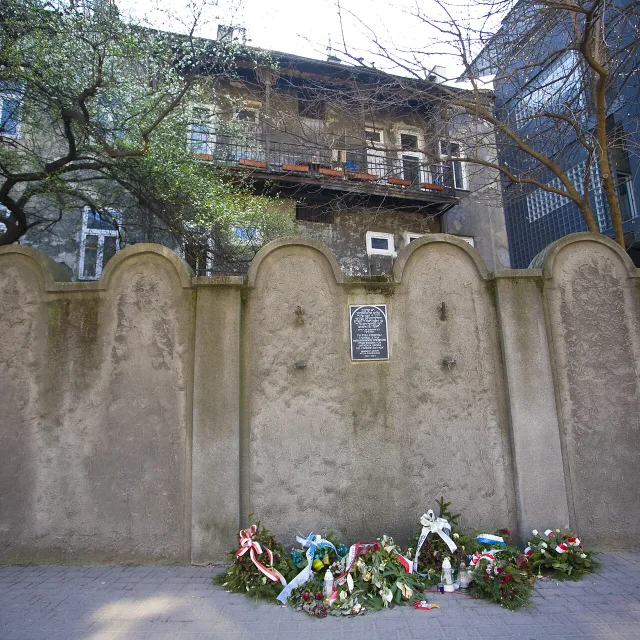
The square itself is a short stop. Fragments of the ghetto wall survive elsewhere in Podgórze, and our page on the ghetto wall fragments explains where they are and what they show. For the wider district, see our page on Podgórze and the former ghetto.
Frequently asked questions
What do the chairs on Heroes of the Ghetto Square mean?
According to the city, the chairs symbolise the tragedy of the Jews, the former residents, of whom only empty chairs remained.
How many chairs are there on the square?
There are 70 in all: 33 chair-monuments made of cast iron and bronze and 37 ordinary chairs on which anyone may sit.
What was the square called during the war?
Plac Zgody. Before that it was called Mały Rynek.
What happened on the square in 1942 and 1943?
The Germans assembled Jews here and then sent them to the German camp in Płaszów or to the railway station, from where they were taken to extermination camps. On 14 March 1943 the Germans assembled some of the ghetto's residents on the square and deported them by lorry to Auschwitz.
Do you need a ticket for Heroes of the Ghetto Square?
It is an ordinary city square; there is no ticket desk and there are no barriers. The Eagle Pharmacy at number 18 is a museum with its own opening hours.
Photo: Ingo Mehling, Wikimedia Commons, CC BY-SA 4.0.
Other places worth seeing
Ready to explore?
Book a tour, hop on an electric cart, or arrange a transfer.