Piarist Church in Krakow: painted altar and Scala Santa
A late Baroque church of the Piarist order, built to a design by Kacper Bażanka, with illusionistic paintings and a chapel of the Holy Stairs in its lower church.
6 min walk from the Main Market SquareDirections
The Piarist Church in Krakow closes Świętego Jana Street from the north, on Pijarska Street, about 100 m in a straight line from Florian Gate. Its official name is Kościół Rektoralny pw. Przemienienia Pańskiego (dedicated to the Transfiguration of the Lord), and it is the church of the college of the Piarist order on Pijarska Street. According to the Piarists, services continued in the church without a break during and after the Second World War.
Visiting the Piarist Church on Pijarska Street
The Piarists give the address of the church as Pijarska 2, 31-015 Krakow. Under the church, in the crypt, the gallery Krypta u Pijarów has operated since 1997. The city authorities write that exhibitions and patriotic performances are held in the crypt. The Easter tradition of building a Holy Sepulchre (Grób Pański) in the crypt still continues.
Current visiting arrangements are listed on the website of the Piarist church on Pijarska Street.
What to see at the Piarist Church
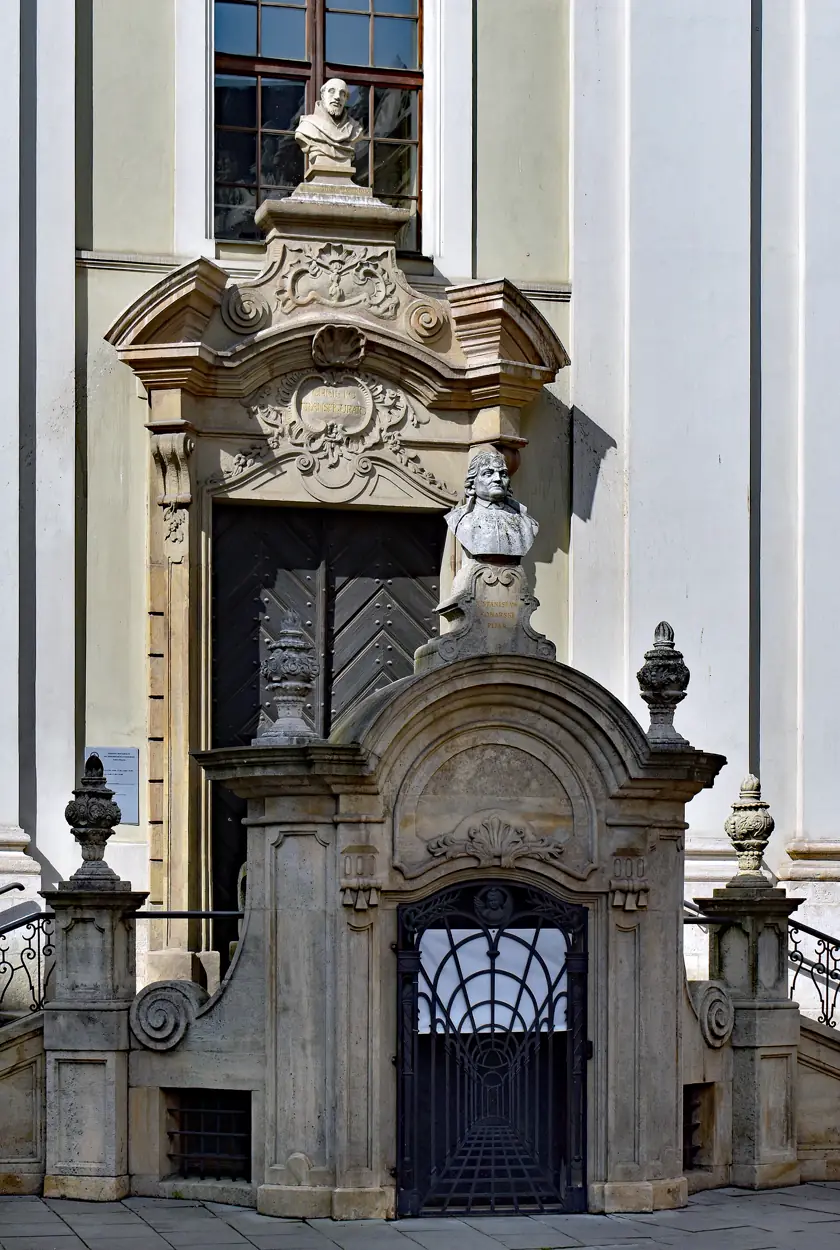
Francesco (Franciszek) Placidi gave the church its three-storey façade, with an openwork gable in the form of a small turret (sygnaturka) rising above the roof. Two-flight stairs stand on both sides of the gate that leads to the crypt; the present stairs date from 1933. A marble bust above the portal shows Father Stanisław Konarski, a Piarist and a reformer of schools in the First Polish Republic, whose ideas paved the way for the Constitution of 3 May. The bust was placed there on the hundredth anniversary of the Constitution.
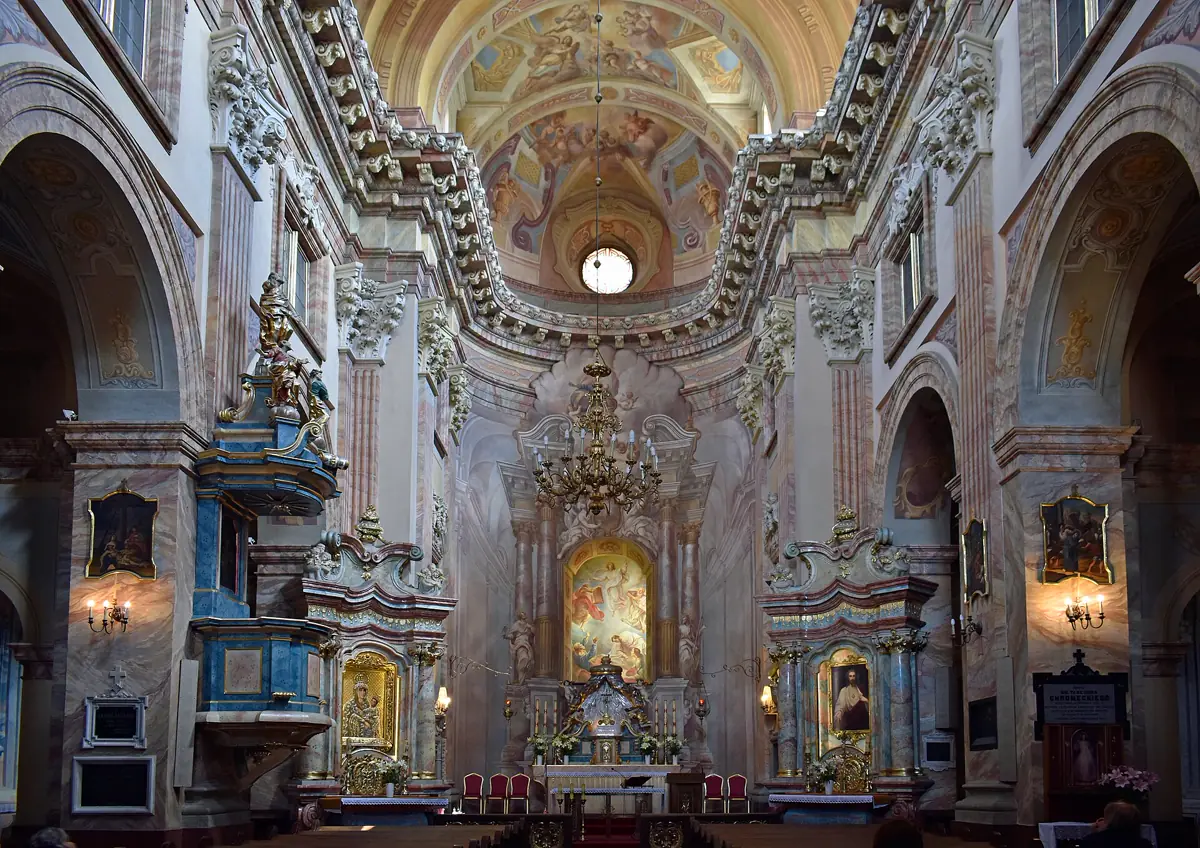
The church has a rectangular plan and a single nave, the main space for the congregation, with side chapels open to it. This layout follows Jesuit churches of the Il Gesù type, named after the church in Rome.
Franciszek Eckstein and Józef Piltz, two painters from Moravia, painted the illusionistic murals in 1733, following the Roman tradition of Andrea Pozzo. Eckstein painted the entire architectural high altar, and the Piarists write that it is hard to believe it is only a painting. At its centre is the scene of the Transfiguration, once lit by daylight from small windows in the vault above the apse, the rounded end of the church.
The barrel vault of the nave, with small curved openings called lunettes, is covered with frescoes by Eckstein. They give the impression of one more storey, with a heaven full of saints and angels. The frescoes show the apotheosis of St Peter, who receives the keys of the Kingdom of Heaven from Christ.
There are 3 chapels with altars on each side of the nave. The altars look like marble, but this is an illusion: almost all of the sculptural decoration inside is stucco made to imitate stone.
A late Baroque pulpit hangs on the pillar to the left of the chancel, the area around the high altar. In the side altar on the opposite side of the chancel is an 18th-century painting of Matka Boska Pocieszenia (Our Lady of Consolation). Silver and gold covers, added as a sign of devotion, leave only the faces and hands of the Madonna and the Child visible.
To the right of the altar, the heart of Father Stanisław Konarski, called the patriarch of the Polish Piarists, is set into the wall as a national relic. The urn with his heart was brought to Krakow in 1882.
The Scala Santa chapel in the lower church
Under the church is the chapel of the Holy Stairs (Scala Santa), consecrated in 1733. It belongs to a rare group of Baroque monuments made for contemplation of the Passion of Christ. According to the Piarists, it is probably the only chapel that takes up a whole lower church.
The Holy Stairs are a symbolic copy of the stairs in the Antonia Fortress (Pałac Antoniusza in Polish sources), the seat of the Roman governor in Jerusalem. The stairs were probably designed by Kacper Bażanka.
The right flight has 26 low steps and 2 landings, 28 in all by tradition, and people once climbed it on their knees. The left flight of 23 steps was used for walking down. Particles of the Holy Cross were placed in three of the steps, and small metal crosses mark these places. The original Baroque floor of black and white stone slabs, laid like a chessboard, survives at the top and on the landings of the right flight.
The chapel became so popular in the 18th century that a new entrance straight from the street had to be built, and Placidi directed this work.
The original decoration of the chapel included an altar of the Imprisonment of Christ at the top of the stairs, a grotto of the Holy Sepulchre and an open oculus, a round opening in the vault. Andrzej Radwański painted the Sorrowful Mysteries of the Rosary on the walls. In 1888 the damaged wall paintings were painted over. During repairs in the 20th century the altar was removed and the oculus was walled up. The restoration of the crypt ended in December 2019: newly discovered paintings were conserved and the Holy Stairs were reconstructed.
From 1887 the lower church served as a funeral chapel for distinguished people. The remains of Józef Ignacy Kraszewski, Mikołaj Zyblikiewicz and Stanisław Wyspiański were kept in the crypt for a time. During martial law the crypt was a meeting place for the opposition and for independent artists.
History of the Piarist Church
The Piarists came to Poland from Moravia in 1642. The goodwill of King Jan Kazimierz encouraged them to try to found a college in Krakow, and a royal privilege of 1654 gave them permission. Kazimierz was their first place of settlement in Krakow.
The church was designed by Kacper Bażanka, an architect valued in Krakow, whose works include the Missionaries' church at Stradom and the Annunciation altar in St Mary's Basilica. His sudden death interrupted his work on the design: according to an account the Piarists repeat, he lost consciousness while travelling in winter, fell from a sleigh and froze to death.
The Piarists give the years of construction as 1718-1728, and the same Piarist history records the blessing of the foundation stone in 1724 and the consecration on 28 May 1728. The church was consecrated under two dedications: the Transfiguration of the Lord and the Protection of the Mother of God the Queen. In 1724 the Piarists also opened a school of speculative theology here, which operated until 1785.
The royal architect Placidi completed the building in 1759-1761. In December 1933, on the city's order, the Piarists replaced the damaged sandstone stairs in front of the church with new stairs of hard stone on foundations 4 metres deep. After the Second World War, the college remained the seat of the provincial, the head of the order's province, and became the seat of the Province Archive.
Near the church: Czartoryski Museum and Matejko House
In a straight line, the Czartoryski Museum is about 50 m from the Piarist Church. The Krakow Barbican and the Jan Matejko House are each about 150 m away.
Piarist Church: questions visitors ask
Where is the Piarist Church in Krakow?
At Pijarska 2, at the northern end of Świętego Jana Street. The Piarist College building stands next to it, to the west.
What is the chapel under the Piarist Church?
The chapel of the Holy Stairs, consecrated in 1733, which fills the lower church. Its stairs were reconstructed during the restoration completed in December 2019.
Who painted the inside of the Piarist Church?
Franciszek Eckstein and Józef Piltz, in 1733. Eckstein also painted the high altar, which imitates carved architecture.
Photo: Zygmunt Put, Wikimedia Commons, CC BY-SA 4.0, cropped.
Other places worth seeing
Ready to explore?
Book a tour, hop on an electric cart, or arrange a transfer.