Jan Matejko House in Krakow: tickets, hours and collection
Jan Matejko's family home on Floriańska Street, where he was born, worked and died, is now a branch of the National Museum in Krakow. Its collection includes his sketches and studies, the objects he collected and a set of instruments of torture that he saved from destruction.
The painter Jan Matejko (1838-1893) was born, lived with his family, worked and died in the house at 41 Floriańska Street, now the Jan Matejko House in Krakow. The museum is a branch of the National Museum in Krakow, which lists it as MNK Matejko (in Polish, Dom Jana Matejki), and it is about 100 m from Florian Gate. Entry is paid, but the permanent exhibitions are free on one day of the week.
- Address: Floriańska 41, 31-019 Krakow.
- Opening hours: Tuesday to Sunday from 10:00, closing at 18:00 on Tuesdays and at 16:00 on other days; closed on Mondays (as listed in October 2026).
- Tickets: paid entry; the permanent exhibitions are free on Tuesdays.
- Accessibility: the branch is not accessible to wheelchair users.
Jan Matejko House tickets and opening hours
As listed in October 2026, the Jan Matejko House is closed on Mondays. It opens at 10:00 from Tuesday to Sunday and closes at 18:00 on Tuesdays and at 16:00 from Wednesday to Sunday. The last visitors are admitted to the exhibitions 20 minutes before the branch closes. The ticket office, museum shop and cloakroom stay open until the branch closes. The National Museum also publishes a separate list of special opening hours for 2026.
A standard ticket costs 18 zł per person, and school pupils and students pay 1 zł per person. Tuesday is a day of free admission to the permanent exhibitions. Tickets for exhibitions and events can be bought online.
A tour with a museum guide in a foreign language costs 220 zł plus the admission ticket, and a tour in Polish costs 170 zł plus the ticket. An audio guide in Polish can be rented. The branch has audio description, a sensory basket, a defibrillator, a cloakroom and a baby changing table.
Hours and prices change; check the current details on the National Museum in Krakow website before your visit.
What the Jan Matejko House collection includes
The collection of the Jan Matejko House covers works from every period of the painter's career, early oil studies among them. It holds small compositional sketches for his large history paintings, such as Nicolaus Copernicus of 1871 and Jan Sobieski presents Canon Denhoff with a letter to the Pope… of 1880. The collection also includes portraits of his family and friends and the Self-Portrait from 1887.
The drawings are divided into sketches for compositions from history and studies of portraits, costumes, architecture, landscape and decorative arts. Family caricatures and watercolours with subjects from history have a special place among them. The mementoes also include drawn records of places and objects from the past. The painter often treated them as sketches for his large-format canvases, including those now shown in the gallery of 19th-century Polish art in the Cloth Hall (Sukiennice).
The museum keeps many design cartoons, the preparatory drawings for the painted wall decoration of St Mary's Basilica (kościół Mariacki) in Krakow (1889-1891). According to the National Museum, this wall decoration helped to renew interest in mural painting among Matejko's students Stanisław Wyspiański and Józef Mehoffer.
A large part of the collection is made up of the decorative arts, fabrics, weapons and ethnographic objects that Matejko gathered throughout his life. He often used the crafts, fabrics, clothes and militaria in his collection as props in his work. The collection also contains a set of instruments of torture that he saved from destruction during the renovation of the tower of the former town hall. The National Museum describes the set as unique.
Another object in the collection is a sceptre, described as a symbol of rule in art, which the City Council of Krakow presented to Matejko in 1878. There are everyday objects and mementoes of the artist and his closest family, among them his wife, Teodora z Giebułtowskich Matejkowa (1846-1896). The museum also keeps Matejko's letters to his family and friends.
The founders of the museum collected photographs that record the painter's work, and many of them come from his own collection, including pictures of people who posed for him. His library includes early printed books from the 16th to the 18th century and publications on history and art, often with dedications to the artist. Many Polish and foreign medals, diplomas and certificates of membership in artistic and scholarly societies show the recognition he received.
Objects that are not in the permanent gallery are shown in changing exhibitions. From May 2026 to January 2027 the branch shows a temporary exhibition about satire and comics in Matejko's work, Satyra i komiks u Jana Matejki (as listed in October 2026).
Floriańska 41: from Matejko's house to a museum
Floriańska Street is one of the sections of the Royal Road (Droga Królewska), which runs from Wawel Castle to the north of the country. Because of the importance of this route, there were already buildings on Floriańska Street in the Middle Ages. The house at number 41 was built in the 16th century and was rebuilt several times. The architect Tomasz Pryliński, working with Jan Matejko, the owner of the house, gave the building its final form in the 19th century.
The house was the setting of Matejko's work, his family life and his public activity, above all the study and protection of the heritage of the past. The National Museum presents Matejko as the most outstanding representative of Polish history painting, and also as a collector, a professor and a pioneer of the conservation and protection of monuments. For many years he was director of the School of Fine Arts (Szkoła Sztuk Pięknych) in Krakow, later the Academy of Fine Arts (ASP) in Krakow.
After the artist's death, a society named after him, the Towarzystwo im. Jana Matejki, was founded to honour the painter with a biographical museum. The house was bought from the family, and objects connected with Matejko and his family were gathered there through purchases and donations. These objects were shown to the public for the first time in 1898, five years after the painter's death. In 1904 the society placed its museum under the management of the National Museum in Krakow.
Getting to the Jan Matejko House and accessibility
The National Museum lists tram lines 2, 3, 4, 8, 10, 14, 19, 20, 24 and 52 for the Jan Matejko House. It also lists bus lines 124, 152, 304, 424 and 502.
The branch is not accessible to people who use wheelchairs. The National Museum in Krakow also offers a virtual tour of the branch.
Florian Gate, Czartoryski Museum and other places nearby
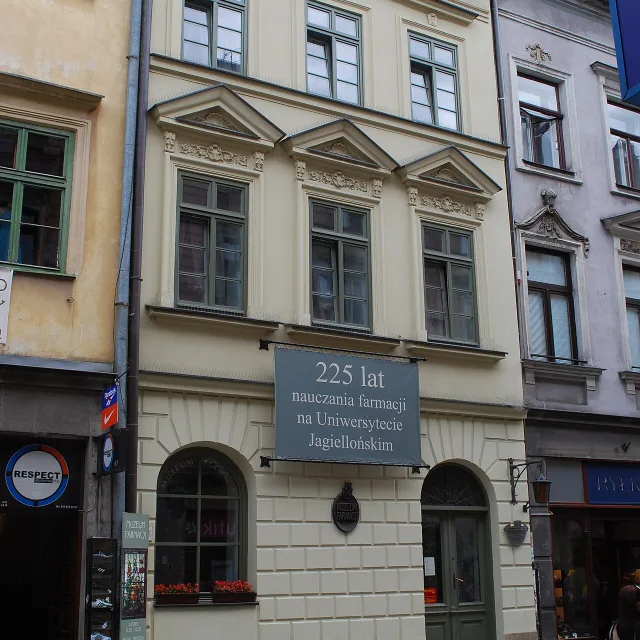
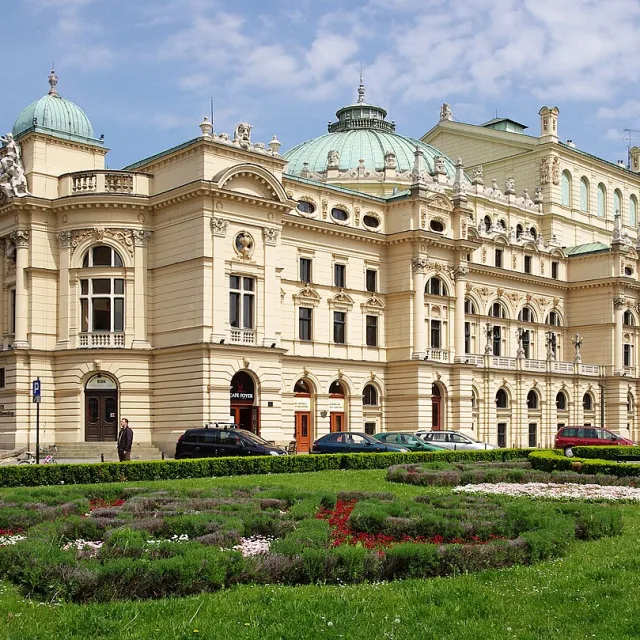
The Museum of Pharmacy and the Czartoryski Museum are each about 100 m away in a straight line, and Florian Gate is also about 100 m away. The Juliusz Słowacki Theatre is about 150 m away.
Jan Matejko House: questions visitors ask
Is the Jan Matejko House free on Tuesdays?
Yes. On Tuesdays, admission to the permanent exhibitions is free, and on that day the house also stays open longer than on other days (as listed in October 2026).
Is the Jan Matejko House open on Mondays?
No. The branch is closed on Mondays and open from Tuesday to Sunday.
Is the Jan Matejko House part of the National Museum in Krakow?
Yes. The National Museum lists it as one of its branches under the name MNK Matejko. The society that created the museum gave it to the National Museum to manage in 1904.
Is there an audio guide at the Jan Matejko House?
Yes, but in Polish only.
Can wheelchair users visit the Jan Matejko House?
No. The branch is not accessible to wheelchair users, but the National Museum offers a virtual tour of it.
Photo: Chris Olszewski, Wikimedia Commons, CC BY-SA 4.0, cropped.
Other places worth seeing
Ready to explore?
Book a tour, hop on an electric cart, or arrange a transfer.