Museum of Engineering and Technology in Krakow's tram depot
A museum of the City of Krakow in a tram depot laid out in 1882-1888, where the exhibition "Miasto. Technoczułość" presents more than 600 technical heritage objects. The museum also shows heritage tramcars in Hall F.
In a former tram depot on Świętego Wawrzyńca Street, the Museum of Engineering and Technology in Krakow presents the history of the city through engineering and technology, with more than 600 technical heritage objects. Its Polish name is Muzeum Inżynierii i Techniki w Krakowie (MIT). The depot stands in Kazimierz. You visit the permanent exhibition inside the depot halls, and an audio guide comes with the ticket.
- Address: Świętego Wawrzyńca 15, 31-060 Krakow
- Run by: the City of Krakow; the museum collects and displays objects on the history and development of technology.
- Exhibition route: on several levels, from level -1 to the upper level of Hall D.
Visiting the Museum of Engineering and Technology
You can enter the listed depot complex whenever the museum is open. An audio guide is included with the ticket, and you collect it at the museum ticket desk. According to the museum's director, speaking to Radio Kraków in 2023, the extended route is entirely indoors: you enter and leave at the same place.
As listed in October 2026, the museum's information and booking desk works from Monday to Friday, 9:00-17:00. Its email address is rezerwacja@mit.krakow.pl. These hours apply to information and booking, not to the exhibition.
The depot on Świętego Wawrzyńca Street is the main site of the museum, which also has two other branches elsewhere in the city. Current visiting arrangements are listed on the website of the Muzeum Inżynierii i Techniki.
What to see in the Museum of Engineering and Technology
The permanent exhibition, Miasto. Technoczułość, tells the history of the city and how the city worked over the centuries. It looks at the city through 12 fields of engineering and technology, among them hydraulic engineering, energy, the gas industry, public health and mobility. Alongside the technical heritage objects, it uses replicas, models, audiovisual material and photographs.
- Polski Fiat 508 and Feldfernschreiber: a car and a cipher machine, both among the museum's unique exhibits.
- Telephones and radios: the first Polish telephones, the Marconi 4LS/1 and Olympic-Z radio receivers, and a luxury Capello Roma music set.
- Strefa LAB: in Hall H, visitors carry out experiments themselves that help them understand the base units of the SI system.
- Hall F: heritage tramcars, which you can see during a visit to the permanent exhibition.
The route starts at level -1 with a prologue and rises to Hall E, which covers the beginnings of the city. It continues through Strefa LAB in Hall H and level -1 of Hall L, with sections on the First and Second Industrial Revolutions and the road towards the present day, and a rest area. The route ends on the upper level of Hall D with post-war modernisation, transformation and an epilogue.
History of the tram depot on Świętego Wawrzyńca Street
On 25 November 1881 the city of Krakow signed an agreement with the Belgian Bank (Bank Belgijski) to set up and maintain a horse railway in the city. A company founded by the bank received a concession from the municipality to build and operate the first tram lines in Krakow. That company built the first depot buildings. The depot complex was laid out in 1882-1888, at first for the horse-drawn tram.
The oldest surviving building, the horse tram depot, was built in 1882, together with stables and administrative and storage buildings. It has a timber frame filled with brick (mur pruski in Polish), a type of construction that is very rare in Krakow. The 1882 buildings followed a design by H. Géron, modified at the request of the municipal services.
Horse-drawn cars ran on the oldest Krakow tram lines until 1901. The horse tram depot was extended in 1896 to a design by Tadeusz Stryjeński and Zygmunt Hendel. In 1900, when the tram lines were electrified, Karol Knaus designed a complex of halls for the narrow-gauge electric tram, with a depot, workshops and a power station. Work on the complex continued from 1900 until the First World War.
The tram power station, built in 1900 to supply the trams, has halls for generators, boilers and batteries. In 1912 a standard-gauge depot for 12 tramcars was built for the Krakowska Spółka Tramwajowa tram company. In 1913 a six-track hall for the standard-gauge tram followed at Świętego Wawrzyńca 12, opposite the museum's address. Karol Knaus also designed this hall, which has walls of the same brick-filled timber frame.
The bus garage, designed by Edward Ronka, dates from 1928, when the Krakowska Miejska Kolej Elektryczna started regular bus lines. In total, 11 buildings stand on a site of about 12,000 square metres: two from 1882-1888, eight from 1890-1913 and one from 1928. After the trams finally left the depot, it held bus workshops and warehouses. Since 1998 the complex has housed the museum, which was formerly called Muzeum Inżynierii Miejskiej (Museum of Municipal Engineering).
The depot complex is entered in the register of monuments. The National Heritage Institute (Narodowy Instytut Dziedzictwa, NID) calls it a complex of heritage urban transport buildings that is unique on a European scale. NID gives two reasons: the timber architecture with brick infill, and the survival of many different urban transport buildings together in one compact complex.
The exhibition Miasto. Technoczułość was created in the last stage of an EU project. It opened at the end of March 2023, and this was the first chance to visit the extended main site. The exhibition received the Wydarzenie Muzealne Roku Sybilla 2023 award, in the category for new and modernised permanent exhibitions.
According to Radio Kraków, more than 300 museum objects were restored as part of the project. They include the G-051 tramcar from the Linke-Hofmann Werke works, from around 1901, and type C car number 260 of 1925 from the Lilpop Rau i Lowenstein works.
Corpus Christi Church and other places near the museum
In a straight line, Corpus Christi Church is about 200 m from the museum. The High Synagogue is also about 200 m away, and so is the Kowea Itim le-Tora Prayer House. The Old Synagogue is about 250 m away. The museum stands in Kazimierz, the district covered by our Kazimierz electric cart tour.
Museum of Engineering and Technology: questions visitors ask
Where is the Museum of Engineering and Technology in Krakow?
At Świętego Wawrzyńca 15 in Kazimierz, in the former tram depot, which is the main site. The museum's two other branches, Ogród Doświadczeń im. Stanisława Lema and Hangar Czyżyny, are in other parts of the city.
What is there to see inside the Museum of Engineering and Technology?
The permanent exhibition Miasto. Technoczułość, with items such as a Polski Fiat 508 car and the first Polish telephones, and Strefa LAB in Hall H. The route also includes heritage tramcars in Hall F.
What is the history of the Museum of Engineering and Technology building?
It is a former tram depot. The complex was laid out in 1882-1888 for the horse-drawn tram and extended for the electric tram from 1900, and the museum has used it since 1998.
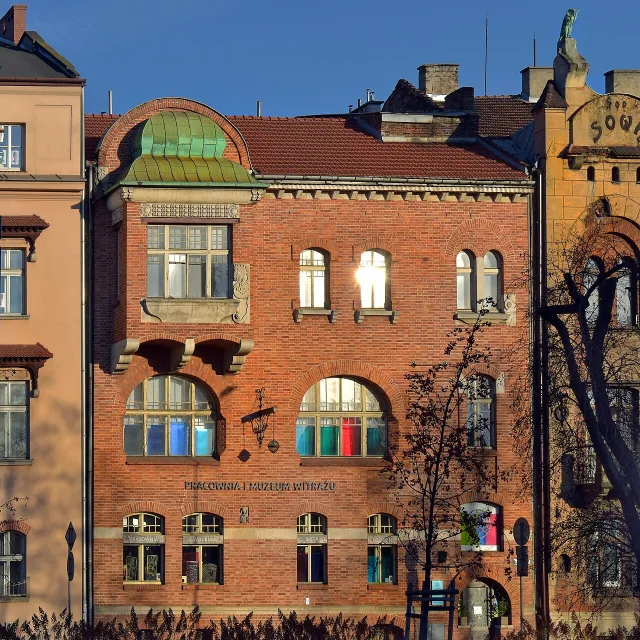
Photo: Miha Peče, Wikimedia Commons, CC BY 4.0, cropped.
Other places worth seeing


Ready to explore?
Book a tour, hop on an electric cart, or arrange a transfer.